

Adam Castillo Released: Evidence Raises Serious Questions About Politically Motivated Charges
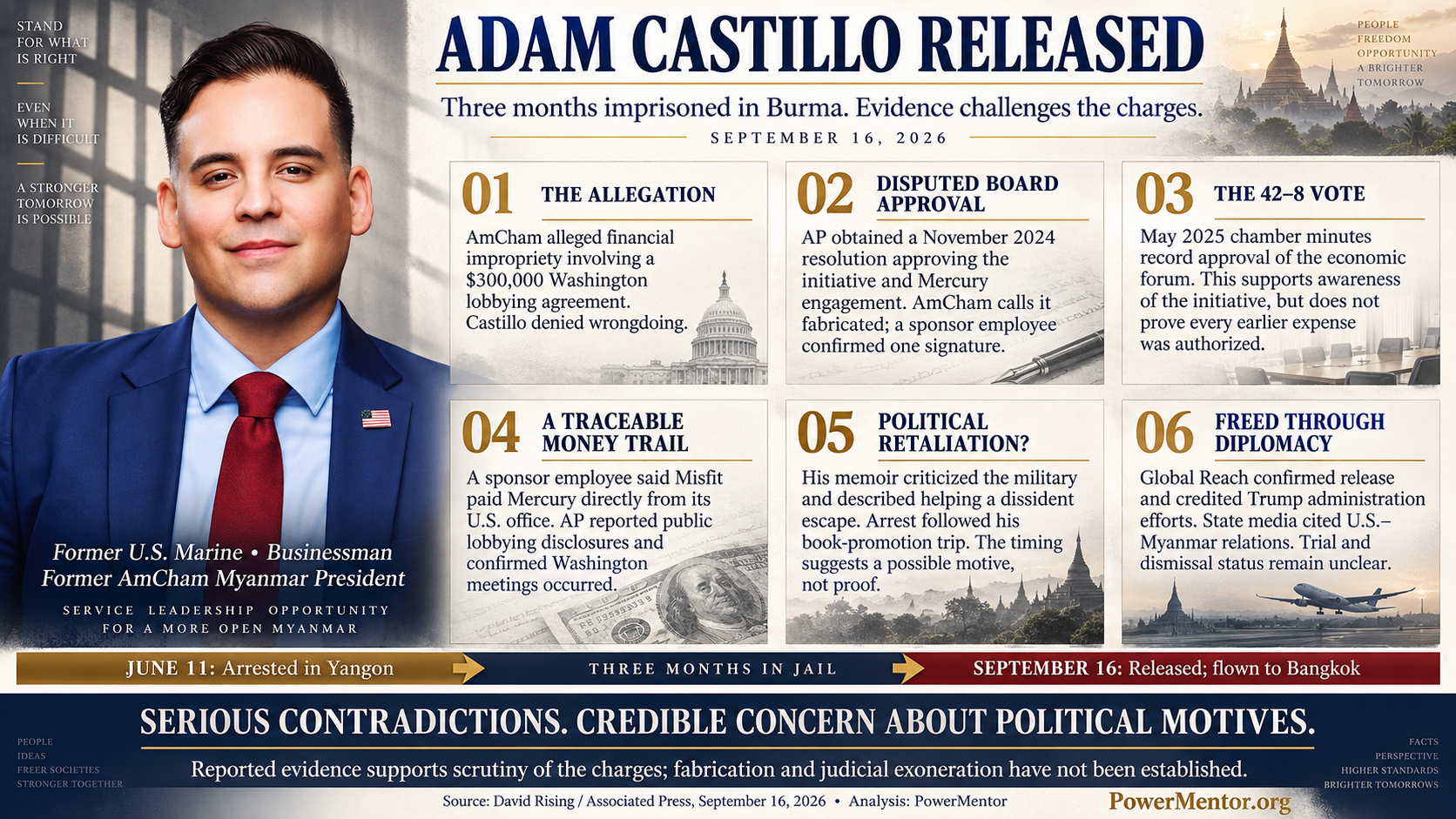
Adam Castillo is free after spending three months imprisoned in Burma. His release brings welcome relief to his family, but it does not resolve the troubling questions surrounding his arrest. Newly reported documents, payment records, and confirmation of lobbying activities challenge central allegations against him and strengthen concerns that his detention was politically motivated.
The American businessman, former Marine, and former president of the American Chamber of Commerce in Myanmar was released into U.S. custody and flown to Bangkok on September 16, with his return to the United States expected to follow. Global Reach, which assisted his family, confirmed his release and credited collaboration with the Trump administration. Myanmar’s state broadcaster explained his deportation in terms of friendly relations with the United States, without clarifying whether the charges had been dismissed or whether he had ever stood trial. Associated Press
For those who followed our earlier coverage, the central question remains: Was Castillo imprisoned for a legitimate financial offense, or did a business dispute provide a convenient basis for political retaliation? The evidence described in the Associated Press report gives substantial reasons to scrutinize the official case.
Documents Challenge the Claim That He Acted Without Approval
The allegations centered on Castillo’s lobbying initiative to strengthen economic engagement between the United States and Burma. The chamber maintained that its board had never approved a $300,000 agreement with Mercury, a Washington public affairs firm.
However, AP obtained a resolution dated November 1, 2024, on chamber letterhead and bearing board members’ signatures, approving the lobbying initiative, sponsorship by Misfit Technologies, and Mercury’s engagement. If authentic, that resolution directly challenges a central premise of the allegations.
The chamber’s executive director called the document fabricated. Yet an employee of Misfit Technologies told AP that the company’s chief executive, Munimul Islam, who was also a chamber board member, had signed it.
That disagreement requires independent examination. The resolution cannot be treated as conclusively authenticated, but the chamber’s denial does not erase the document or the account supporting its authenticity.
The Chamber’s Own Records Show Support for the Initiative
AP also identified minutes on the chamber’s website documenting a May 30, 2025, vote on incorporating the U.S.-Burma Economic Forum into the chamber’s constitution. The proposal passed by 42 votes to eight.
That vote does not establish approval for every earlier transaction. It does demonstrate that the forum was formally considered and received substantial support.
This distinction matters. A disagreement over particular financial arrangements is different from suggesting that an initiative operated entirely without the organization’s knowledge or approval. The meeting records complicate that narrative.
The Payment Explanation Undermines the Inference of Missing Money
Another allegation involved approximately $300,000 that reportedly did not enter the chamber’s bank accounts.
According to a Misfit employee directly involved in the matter, the company’s U.S. office paid Mercury directly because sanctions and Burmese regulations complicated payments from Myanmar. AP reported that Mercury disclosed those payments to American authorities under the Lobbying Disclosure Act.
If a sponsor paid the service provider directly, the absence of those funds from chamber accounts would not, by itself, establish theft, diversion, or personal enrichment.
Public disclosure does not automatically resolve every question about authorization or compliance. It does provide an identifiable payment trail and an alternative explanation that must be evaluated before treating money absent from chamber accounts as evidence of criminal wrongdoing.
AP Confirmed That Lobbying Services Occurred
The chamber’s annual report maintained that it received no services. AP nevertheless confirmed that Mercury organized and attended multiple Washington meetings involving Castillo and others.
Whether those meetings fulfilled every contractual obligation or delivered the intended benefit to the chamber remains a separate question. But confirmation that the work occurred challenges any broad suggestion that the arrangement produced no actual services.
Taken together, the disputed authorization, formal membership vote, direct-payment explanation, and confirmed meetings provide substantive grounds for questioning the case. These are concrete evidentiary issues, beyond the understandable support of Castillo’s family and friends.
His Criticism of the Military Provides a Plausible Political Motive
The circumstances surrounding Castillo’s arrest add another dimension.
He was detained at Yangon International Airport on June 11 after returning from Malaysia, where he had been promoting his memoir. The book criticized Burma’s military and chamber leadership. It also described helping a dissident escape the country.
Casey Barnett, a former American Chamber of Commerce president in Cambodia who knew Castillo, told AP that the memoir’s criticism could have drawn the authorities’ attention.
The combination of outspoken criticism, a published account of assisting a dissident, and arrest after a book promotion trip creates a credible basis for suspecting retaliation. It does not establish who ordered the arrest or prove the authorities’ motives. Nevertheless, it belongs at the center of any serious examination of why this dispute resulted in imprisonment.
Castillo’s opposition to broad U.S. sanctions should not obscure his criticism of the military. Advocating economic engagement did not mean endorsing military rule.
A Diplomatic Release Leaves the Legal Questions Unanswered
The government’s explanation for Castillo’s departure emphasized relations with the United States. The announcement, as reported by AP, did not provide a clear legal resolution.
That supports the conclusion that diplomacy figured in his release. It does not independently prove that the original arrest was politically directed. But it leaves a troubling gap between the criminal allegations used to justify his detention and the diplomatic language used to explain his freedom.
Release and exoneration are different outcomes. Castillo’s family can celebrate his freedom while still seeking clarity about the accusations that cost him three months of his life.
Why Suspicions of Trumped-Up Charges Deserve Serious Attention
The strongest argument that the charges were trumped up rests on the combined weight of the reported contradictions: disputed evidence of board authorization, documented organizational support, a traceable explanation for payments, and confirmation that services were delivered. His criticism of the military provides a plausible political context.
These facts support serious concern that an organizational dispute may have been used as a vehicle for political punishment. They do not yet establish that every allegation was knowingly fabricated or that chamber officials coordinated retaliation with the military.
That distinction strengthens the argument by keeping it anchored to evidence. The public record described by AP warrants scrutiny, independent authentication of the disputed documents, and a clear account of what happened.
Freedom Must Be Followed by Answers
Castillo’s release is welcome news. His family, Global Reach, and the U.S. officials who helped secure his freedom deserve recognition.
Questions also remain about others implicated in the case. AP could not establish whether the Australian former chamber executive director arrested in the matter had been released.
For PowerMentor, the demand is straightforward: clarify the status of the charges, examine the disputed records independently, explain the financial allegations in light of the payment trail, and account for the other defendants.
Adam Castillo has regained his freedom. The evidence challenging the case against him deserves a full and transparent hearing.
