

When the Threat Is Inside the Cockpit
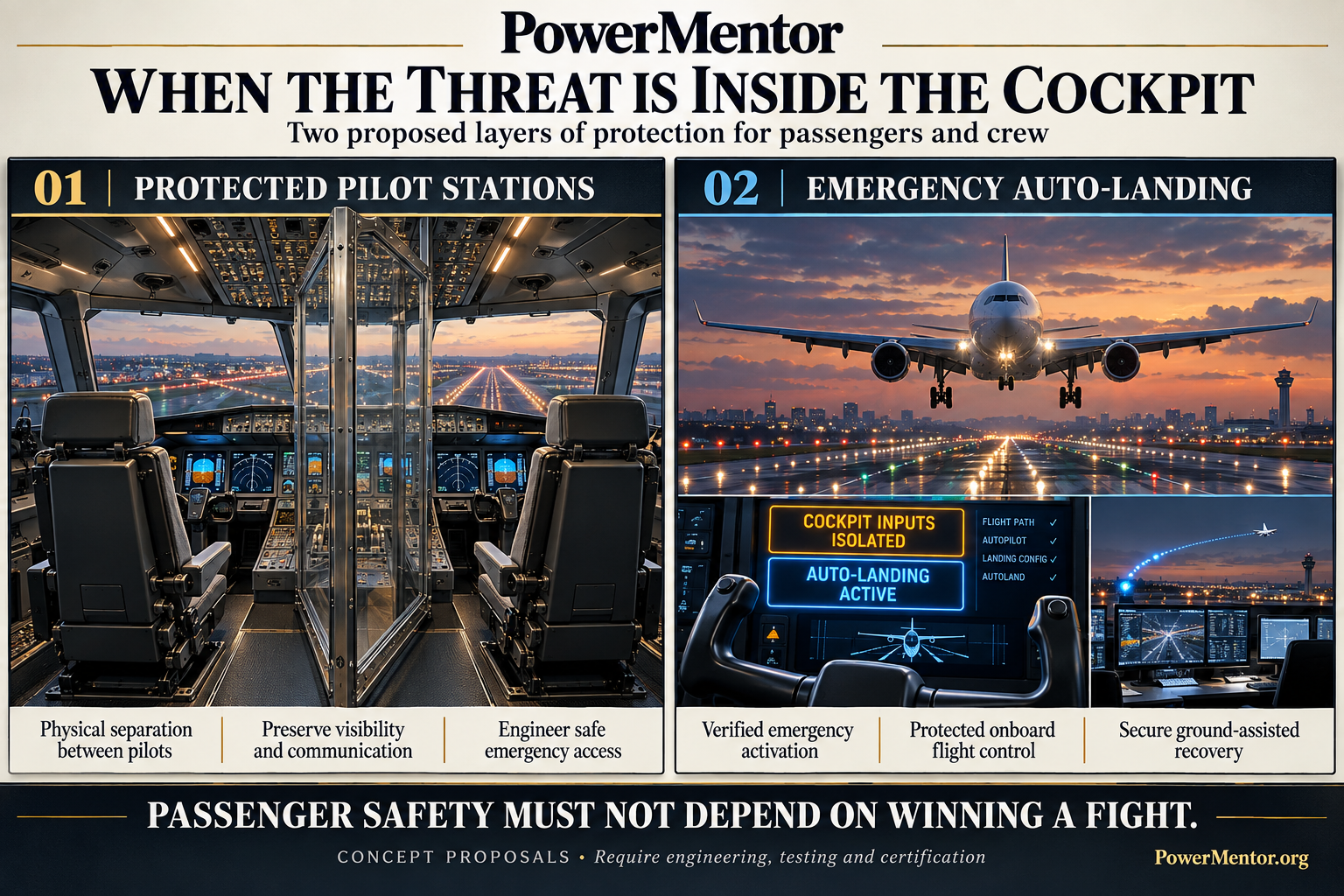
Fortified doors exposed a dangerous gap in aviation security. Protecting passengers requires another layer of defense.
A passenger aircraft should never become a place where one person can condemn everyone aboard to death while those capable of stopping it are locked outside.
After September 11, aviation security placed greater emphasis on preventing unauthorized entry into the cockpit. Reinforced doors became a critical defense. But that protection carries a vulnerability: when the threat is already inside, the same barrier can prevent rescue.
This concern is grounded in documented tragedies. It deserves a serious engineering response.
In November 2013, LAM Mozambique Airlines Flight 470 crashed in Namibia, killing 33 people. The captain remained alone after the first officer left the cockpit. Investigators documented commands directing the aircraft downward, along with recorded knocking and calls from people trying to regain access.[1]
In March 2015, Germanwings Flight 9525 crashed in the French Alps, killing 150 people. The first officer deliberately initiated the fatal descent and kept the captain locked out. France’s aviation investigation authority, BEA, explicitly concluded that the cockpit’s resistance to forced entry made intervention impossible before impact.[2]
Together, those two disasters killed 183 people. They establish that cockpit exclusion can prevent lifesaving intervention. They do not establish that reinforced doors caused the pilots’ intentions, or that every unexplained crash belongs in the same category.
The September 30, 2026, Flydubai incident raises the issue again. According to Israeli officials cited by Reuters, a co-pilot attacked the captain and attempted to crash the aircraft before passengers and crew intervened. A spokesperson said the injured captain managed to release the cockpit door. The motive remains under investigation, and the airline has cautioned against premature conclusions.[3]
If that account is confirmed, it illustrates how access to help can determine whether a cockpit emergency becomes a mass-casualty disaster.
Successful intervention also occurred in October 2023, when an off-duty pilot occupying a cockpit jump seat attempted to shut down the engines of a Horizon Air passenger flight. The operating pilots intervened and landed safely. The off-duty pilot subsequently pleaded guilty to interfering with the flight crew.[4]
These events differ in circumstances and intent. They share a question that aviation leaders must confront: What protects the passengers when someone trusted with cockpit access becomes the danger?
Rarity is relevant to assessing risk. So is the consequence of failure. A responsible response must preserve existing hijacking defenses while developing protections against threats within the flight deck.
PowerMentor recommends a funded, time-bound initiative led by aviation regulators, manufacturers, airlines, pilots, cabin crews, cybersecurity specialists, and human-factors experts.
First, evaluate protected pilot stations.
A transparent, impact-resistant partition between pilots could reduce the opportunity for one pilot to physically attack the other. It should preserve clear communication, shared situational awareness, and access to necessary controls.
The design would also need to allow evacuation and assistance during a medical emergency. A barrier that blocks lifesaving aid could introduce another hazard.
Physical separation alone would not prevent deliberate misuse of aircraft controls. Research must therefore address how the aircraft handles conflicting commands and protects critical systems. No partition should be presented as a complete solution.
Second, develop independent emergency flight protection.
An aircraft facing a verified cockpit takeover should have a protected means of maintaining safe flight. The research objective should include stabilizing the aircraft, preventing destructive commands, and navigating toward a suitable airport.
Emergency autonomous landing already exists on selected smaller aircraft. Garmin has certified systems capable of controlling and landing an aircraft during an emergency without human intervention.[5] This demonstrates a useful technological foundation. It does not mean existing systems can simply be installed on airliners or defeat deliberate sabotage.
An airline-capable system would require rigorous testing across aircraft failures, weather, airport conditions, and false alarms. It must distinguish a legitimate emergency maneuver from a dangerous command. It must also remain effective when someone deliberately tries to disable it.
Third, evaluate secure ground-assisted takeover and landing.
Specially trained ground pilots could potentially help recover an aircraft whose cockpit has been compromised. The concept should include the ability, after independently verified authorization, to isolate dangerous cockpit inputs and direct the aircraft toward a safe landing.
This capability must not create a new route for hijacking. Strong authentication, multiple authorized approvals, and protection against malicious commands would be essential. NASA research into shared airborne and ground operations identifies secure, highly reliable communications and supporting automation as safety-critical requirements.[6]
The aircraft must also remain safe if the connection disappears. For that reason, onboard emergency protection should be the foundation, with ground assistance providing another layer of recovery.
The hardest design question is authority: how to prevent a dangerous pilot from cancelling a legitimate rescue while preventing an erroneous takeover from disabling a capable crew. That problem requires evidence, testing, and certification before deployment.
Fourth, strengthen the human protections now.
Engineering work will take time. Airlines can continue strengthening confidential support, credible-threat reporting, medical evaluation, and procedures for intervention.
Germanwings investigators identified concerns including fear of losing flying privileges, financial consequences, and unclear rules about medical confidentiality. A system that makes seeking help feel like professional ruin creates incentives to conceal problems.[2]
European reforms have already introduced requirements concerning pilot support programs, psychological assessments, and substance testing.[7] These efforts must be evaluated for how effectively they identify danger and help people receive care. Seeking mental-health treatment should be encouraged; a diagnosis alone does not establish violent intent.
Regulators should publish a research timetable, test proposed protections against both insider threats and external hijacking, and report the results. Solutions that demonstrate a net safety benefit should move toward certification and implementation.
Passengers should not have to depend on an injured captain opening a door, a colleague winning a fight, or a stranger rushing forward at exactly the right moment.
Courage will always matter in an emergency. Aviation design should give that courage a stronger system to work with.
The cockpit must protect the people entrusted to operate the aircraft—and the passengers whose lives depend on them.
PowerMentor — PowerMentor.org
Reporting reflects information available September 30, 2026. The proposed partition and emergency takeover capabilities are research and certification recommendations, not claims of currently available airline safeguards.
Sources:
