

When a Generation Stops Trying: A PowerMentor Perspective on Disengagement—and How Purpose Changes Everything
At PowerMentor, we spend our time with young adults others have already written off.
Not because they are lazy.
Not because they lack intelligence.
But because somewhere along the way, hope broke.
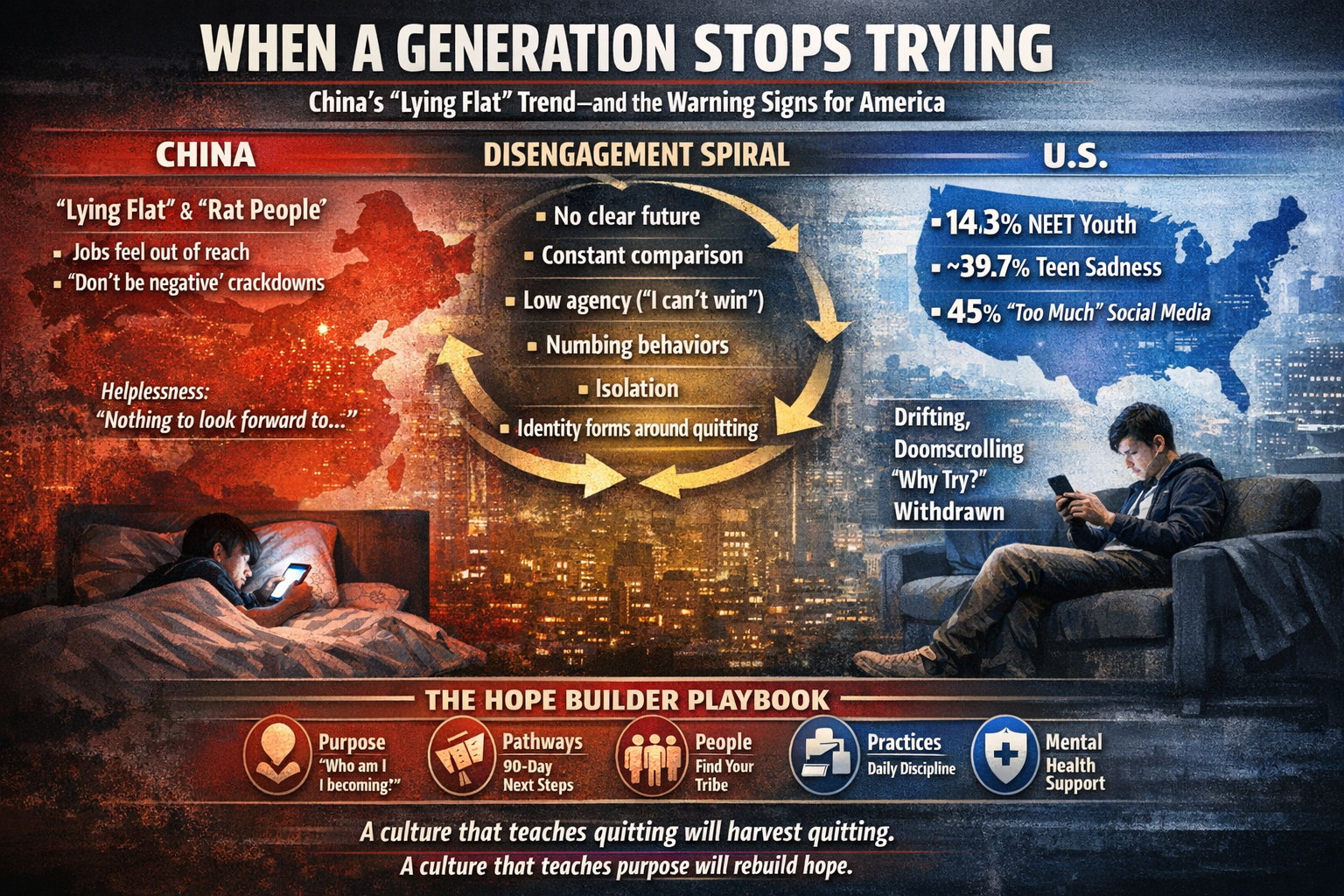
What China now calls “lying flat”—choosing to disengage from work, ambition, and effort—is not a foreign anomaly. It is a warning signal. And it is one we would be foolish to ignore.
Because we are seeing the early versions of the same collapse here in the United States.
Disengagement Is Not Rebellion—It Is Resignation
In China, young people have given a name to what they are feeling:
“Why try if the future is closed?”
They sleep late. Scroll endlessly. Do the minimum. Some openly identify as “rat people,” existing rather than building, waiting rather than striving.
This is not protest.
It is psychological surrender.
And while the language differs, the emotion is familiar to us in the U.S.
We see it in young adults who:
drift after high school or college
feel overwhelmed by comparison
retreat into screens
quietly believe they are behind—and always will be
In data, this shows up as NEET youth—young people Not in Education, Employment, or Training.
In real life, it shows up as lost momentum, lost confidence, and lost purpose.
The Crisis Beneath the Crisis
Here is what PowerMentor has learned through years of frontline work:
Young people do not disengage because life is hard.
They disengage because life feels meaningless.
You can survive hardship if you believe your life has direction.
You cannot endure effort indefinitely if you believe it leads nowhere.
This is not first an economic crisis.
It is an identity crisis.
A generation taught how to perform—but not why they matter—will eventually opt out.
Why Shame, Censorship, and Softening Standards All Fail
China’s response has been to suppress pessimism and police narratives.
Much of the West’s response has been to excuse disengagement or lower expectations.
Both approaches miss the point.
You cannot shame a young person into hope.
You cannot medicate or entertain someone into meaning.
And you cannot remove responsibility and expect purpose to appear.
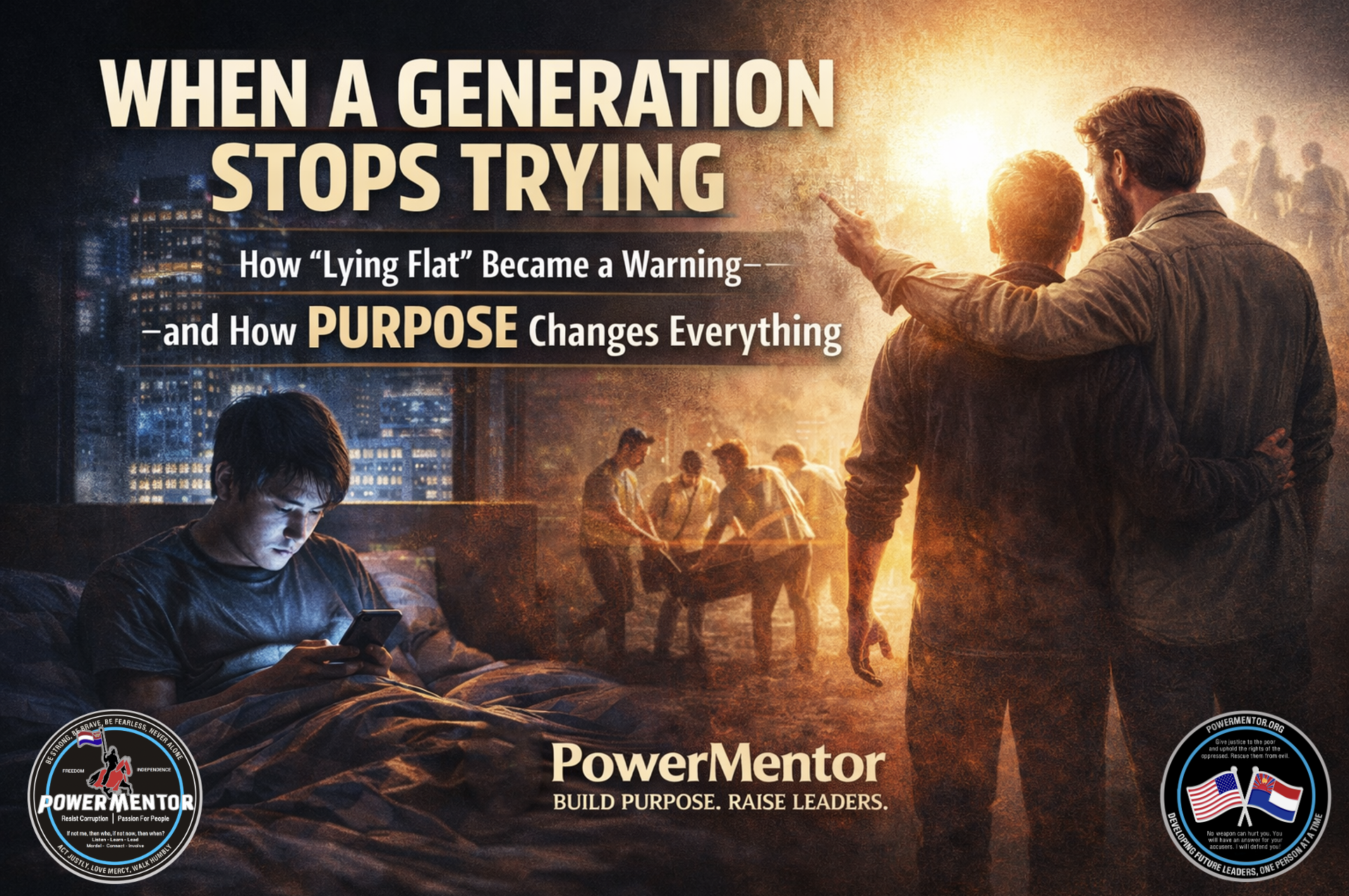
At PowerMentor, we’ve learned something different:
Purpose is not discovered by accident.
It is engineered—through structure, belonging, and responsibility.
The PowerMentor Antidote: Re-Engineering Purpose
This is the heart of the PowerMentor model.
We do not start with résumés.
We do not start with politics.
We do not start with motivation speeches.
We start with purpose formation.
1. Identity Comes Before Achievement
At PowerMentor, young adults are challenged with a deeper question than “What do you want to do?”
We ask:
Who are you becoming?
When identity is clear:
failure becomes feedback
discipline becomes self-respect
effort becomes meaningful
Without identity, success feels empty.
With identity, struggle becomes formative.
2. Belonging Before Ambition
Isolation is the accelerant of disengagement.
That’s why PowerMentor is built around:
mentorship
brotherhood and sisterhood
accountability
intergenerational leadership
Belonging creates gravity.
It pulls people forward even when motivation fades.
Young adults do not rise alone.
3. Contribution Before Consumption
Endless consumption numbs the soul.
At PowerMentor, purpose is awakened through:
service
leadership roles
humanitarian response
responsibility that matters
Young people come alive when they realize:
“Someone is counting on me.”
Contribution turns passive lives into meaningful ones.
4. Structure Over Mood
Waiting to “feel ready” is how disengagement becomes permanent.
PowerMentor emphasizes:
daily discipline
physical readiness
mental resilience
consistent action
Structure restores agency.
Agency restores confidence.
Confidence restores hope.
5. Hope Is Transmitted Through Example
PowerMentor does not sell slogans.
We model hope.
We place young adults beside leaders who:
have suffered and endured
serve without posturing
live with conviction
Hope is not taught from a podium.
It is caught through proximity.
What’s at Stake
A generation that stops trying does not simply stall progress.
It weakens:
families
communities
leadership pipelines
nations
History shows us this truth again and again:
Civilizations do not fall when young people fail.
They fall when young people disengage.
The PowerMentor Commitment
PowerMentor exists for one reason:
To intercept disengagement before it hardens into identity.
We believe:
young adults are not broken
purpose can be rebuilt
leadership can be cultivated
hope can be restored
But only if we act intentionally, not accidentally.
Final Word
A culture that teaches quitting will harvest quitters.
A culture that engineers purpose will raise leaders.
PowerMentor chooses purpose.
PowerMentor chooses responsibility.
PowerMentor chooses hope—lived, not preached.
And we invite others to do the same.
