
When a Country Becomes a Captive: Ne Win’s Burma Playbook—and Why Americans Argue About Similar “Soft” Tactics Today
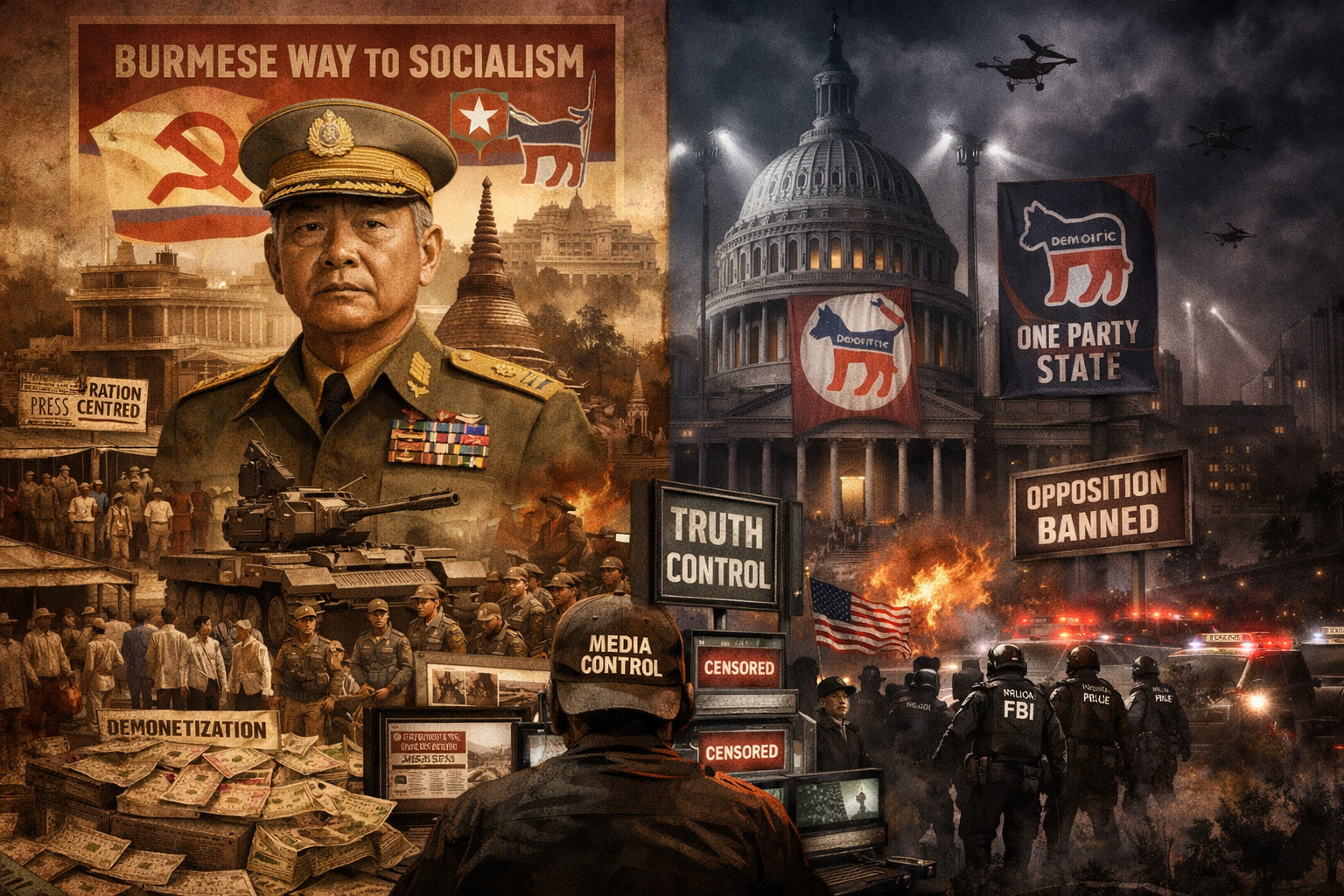
People throw around the phrase “one-party state” too casually. If you want to understand what it actually looks like in real life, you study General Ne Win—because he didn’t just “govern poorly.” He captured Burma (Myanmar) and rebuilt it so competition, dissent, and independent information could not survive.
Then you ask the harder question: Are there modern “tactic rhymes” inside U.S. politics—specifically on the Democratic side—where control is pursued through softer mechanisms like institutional pressure, platform gatekeeping, and opposition-delegitimization?
Part I — What Ne Win Actually Did: The Authoritarian Blueprint
1) He converted politics into a legal monopoly
Ne Win took power by coup in 1962, and the regime built the “Burmese Way to Socialism” with the Burma Socialist Programme Party (BSPP) as the sole legal party.
A key legal step was the 1964 Law to Protect National Unity, which formally banned all political parties except BSPP and confiscated their assets—this is what “destroying the opposition” means in real terms.
This is the bright line: Ne Win didn’t “beat rivals.” He outlawed them.
2) He built censorship as a permanent state function
Ne Win’s regime didn’t just dislike critical press. It nationalized newspapers, then built a Press Scrutiny Board to impose strict censorship—an apparatus that, by many accounts, remained influential for decades.
This was branded as “fact-checking.” It was the state controlling what could exist in print.
3) He normalized arbitrary power (the public learns helplessness)
Authoritarian systems don’t only win by police force. They win by teaching the population that planning is useless because the ruler can change the rules overnight. Ne Win’s era is remembered for exactly that kind of governance—sudden, sweeping decisions with no accountability or public recourse.
Net effect: People stop believing reform is possible, talent leaves, institutions rot, and fear becomes the organizing principle of society.
Part II — The U.S. Claim: “Soft” One-Party Drift Through Control of Information and Delegitimizing the Opposition
In comparison: the argument is not that Democrats have tanks in the streets or outlawed Republicans. It’s that control can be pursued without formal bans—through softer levers that can still tilt the playing field.
Here are the strongest “tactic-parallel” categories people point to.
Tactic Parallel 1: Information Control (Hard Censorship vs Platform/Institutional Gatekeeping)
Ne Win: censorship by law and board
A state board scrutinizes content; newspapers are nationalized; privately owned press is suppressed.
U.S. analogue critics cite: moderation ecosystems + government pressure concerns
In the U.S., the closest parallel people argue is state-linked pressure on intermediaries (social media platforms) to suppress or throttle content.
The central modern legal flashpoint was Murthy v. Missouri (2024)—a case alleging that government officials coerced or significantly encouraged platforms to moderate speech. The Supreme Court did not decide the coercion claim on the merits; it held the plaintiffs lacked standing (they didn’t adequately prove a traceable injury).
Why this matters: even without a legal finding of censorship, the controversy captures the underlying concern: you can shape public speech indirectly by leaning on gatekeepers.
Many warned that some of the same pressure tactics used by authoritarian systems surfaced in a modern democracy—less through tanks and formal bans, and more through institutional capture and cultural coercion. Evidence revealed that when ideology is pushed through key institutions—education, media, corporate policy, professional licensing, and bureaucracy—it can function like a “soft” version of one-party control: shaping what can be said, what can be taught, and what views are socially permitted. In this view, dissent is met not with open debate but with punishment by exclusion—career damage, platform removal, public shaming, and “cancellation”—creating a chilling effect that pressures people to conform. Evidence of battles over issues like gender identity policies, speech codes, and religious expression as flashpoints where disagreement can be treated as moral disqualification, including claims of hostility toward Christianity in public life. The warning is not that America has already become Ne Win’s Burma (Myanmar), but that the tactical logic rhymes: control the institutions, control the narrative, isolate dissent, and over time make real pluralism harder to sustain.
Where the “rhyme” exists:
Ne Win: “Control the press to control reality.”
U.S. critics allege: “Control the digital distribution channels and ‘trust systems’ to control reality.”
Where it breaks:
Ne Win used legal prohibition and state boards.
The U.S. has litigation, elections, competing platforms/media, and constitutional constraints, however, tactics to ban the Republican nominee for president from ballots and other issues were designed to, in essence, create a single-party system with no dissent.
Tactic Parallel 2: Opposition Delegitimization (Turning Politics into Moral Excommunication)
Ne Win: “Opposition = threat to national unity”
Ne Win’s one-party model framed opposition as a danger to unity and the nation—then banned it.
U.S. analogue critics cite: “The other side is illegitimate”
A core “soft-authoritarian” tactic in many countries is not banning rivals first—it’s persuading the public they don’t deserve equal rights of participation. You see this pattern when political language shifts from:
“They’re wrong” → to → “They’re dangerous” → to → “They’re illegitimate.”
Critics argue Democrats do this to Republicans through institutional messaging and media alliances; Democrats argue it’s a response to real threats. The reality is that delegitimization rhetoric is now a broad feature of U.S. polarization, not exclusive to one party—but the tactic type is real. to ultimately have one ruling party.
Where the “rhyme” exists: undermining the idea of legitimate competition.
Where it breaks: Republicans remain fully legal, competitive, and often victorious at state and federal levels—meaning the system remains contested.
Tactic Parallel 3: “Institutional Capture” Instead of a Coup
Ne Win: capture the state directly
Coup → one-party law → censorship apparatus.
U.S. analogue critics cite: capture by institutions, not tanks
In a constitutional system, “capture” doesn’t look like a coup. Critics argue it looks like:
bureaucratic rulemaking as politics,
NGO/academia/media alignment,
corporate policy enforcement,
platform governance,
administrative choke points.
Whether you agree or not, that is the modern version of the same strategic concept: control the institutions that decide what is acceptable, visible, fundable, and punishable.
Part III — The Honest Verdict: Similar Tactical Shapes, Different Regime Reality
If you want credibility, you have to say this plainly:
Ne Win destroyed Burma (Myanmar) through hard authoritarian mechanics
one legal party, others banned
censorship as government function
governance by coercion and fear
The U.S. debate is about soft power drift, not formal monopoly
controversy over government/platform interactions exists, but courts have not broadly ratified a “state censorship” narrative (Murthy ended on standing).
the U.S. still has competitive elections and strong pluralism watchdogs that rate it “Free,” while still noting problems and polarization.
So the clean conclusion is:
Ne Win shows what happens when control becomes law and force.
The U.S. argument is whether “control” is being pursued through pressure, gatekeepers, and delegitimization—banning anyone—until competition becomes a formality.
That’s the warning people are trying to articulate when they say “one-party drift.” It’s less “we’re already there,” and more: the direction of travel matters, because systems don’t collapse overnight—they normalize the tactics first.
Below is a comprehensive map of the recurring assertions Republicans (elected officials, major GOP committees, and aligned investigations/platform documents) have made accusing Democrats of corruption and “institutional capture.” I’m listing the claims as Republicans frame them—not vouching for accuracy.
1) Corruption, influence-peddling, and “pay-to-play”
The “Biden family influence-peddling” claim: Democrats (especially President Biden and allies) allegedly used public office to enrich family/associates via foreign business ties, shell companies, introductions, meetings, or policy influence.
Obstruction/stonewalling oversight: Democrats allegedly slow-walk, refuse, or block document production, testimony, subpoenas, and transparency to conceal corruption. (Often paired with contempt claims.)
Preferential treatment / “two-tier justice” for connected Democrats: allegations that politically connected Democrats receive leniency compared with conservatives. (This is a core theme in “weaponization” messaging.)
Patronage / cronyism claims: appointments, grants, contracts, or regulatory carve-outs allegedly steered to allies/donors/interest groups.
2) “Weaponization” of DOJ, FBI, and federal law enforcement
DOJ/FBI “weaponized against conservatives”: claim that Democrats direct or influence DOJ/FBI priorities to investigate/prosecute conservatives (and/or protect Democrats).
Selective prosecution / “lawfare”: claim that Democratic prosecutors and/or Democratic-aligned institutions use criminal/civil process to damage Republican candidates and movements, especially around high-profile Trump-era cases (often described as coordinated or politically timed).
Retaliation/whistleblower suppression: claims that agencies punish internal dissenters and protect leadership narratives (often raised in hearings and committee reports).
3) Intelligence community & surveillance abuse (FISA / “Russia probe” themes)
FISA abuse against Trump campaign / conservatives: claim that Democrats (and Democratic-aligned officials) relied on flawed/biased information to obtain surveillance authority and sustain politically motivated investigations.
Broader “politicized intelligence” claim: that national security tools get turned inward against domestic political opponents.
4) IRS and financial enforcement used to target conservatives
“IRS targeted conservative groups”: claim that conservative nonprofits were singled out for extra scrutiny/delays and that Democrats bear responsibility for the climate/leadership that enabled it.
5) Government-backed censorship and “information control”
Government pressure on social media to suppress conservative speech: claim that Democrats coordinated with or leaned on platforms to downrank/remove content on COVID, elections, and other topics—framed as unconstitutional censorship-by-proxy.
“Censorship-industrial complex” narrative: claim that agencies, NGOs, academics, and platforms formed an ecosystem to label right-leaning views as “mis/disinformation” and throttle reach.
Suppressing damaging stories (e.g., “laptop” / scandals): framed as Democrats + institutions + media/platforms coordinating to protect Democrats electorally (often discussed as a pattern even when not tied to one document).
Scientific/medical narrative control during COVID: claim that Democratic officials influenced what could be said/published, including pressure on journals and dissenting experts.
Executive-branch framing (from a GOP administration): “ending federal censorship” language is used to formalize the claim that prior Democratic administrations infringed speech.
6) Election interference / “rigging the rules” (institutional rather than ballot-box claims)
Rule changes that benefit Democrats: claims about expanded mail voting, loosened verification, ballot harvesting, emergency rulemaking, or selective enforcement—framed as systematically advantaging Democrats.
Private money influencing election administration (“Zuckerbucks”): claim that private grants embedded staff/resources disproportionately in Democratic jurisdictions and affected turnout margins.
Big Tech + government + media shaping the electorate: claim that moderation decisions and narrative suppression functioned as de facto election interference (ties directly to the censorship allegation set).
7) “Institutional favoritism” via DEI, education, and civil rights enforcement
DEI/“equity” as legalized favoritism: claim that Democrats use federal funding, contracting rules, hiring preferences, and civil-rights enforcement to advantage favored identity/political groups and punish dissenters.
“Indoctrination” in K-12 / universities: claim that Democrats and allied institutions push ideological curricula (race/sex/gender frameworks) and suppress parental rights or viewpoint diversity.
8) Administrative state overreach to bypass voters (regulators as lawmakers)
“Unelected bureaucrats” making policy: claim Democrats use agencies (EPA, OSHA, HHS, etc.) to impose rules Congress didn’t pass—often tied to climate, labor, healthcare, and education.
Selective enforcement: claim agencies enforce rules harder against conservative individuals/industries/states and go softer on Democratic-aligned ones.
9) Media and cultural institutions as partisan machinery
Mainstream media as Democratic “communications arm”: claim that legacy media disproportionately protects Democrats, amplifies Democratic narratives, and applies different standards to Republicans (a major, constant GOP assertion; also echoed in platform-style messaging).
Academia/NGOs/foundations as gatekeepers: claim that grants, credentials, and “expert” institutions are ideologically captured and used to delegitimize conservative positions.
10) Congressional/process claims: obstruction, contempt, and “cover-ups”
Refusal to cooperate with investigations: claims that Democratic witnesses/officials dodge subpoenas or provide misleading testimony; Republicans sometimes pursue contempt or criminal referrals.
Document retention/destruction narratives: claims that key records are withheld, slow-walked, or conveniently “missing.”
