

Venezuela, Voting Machines, and the Battle for the Republic: The Story They Say You Were Never Meant to Connect
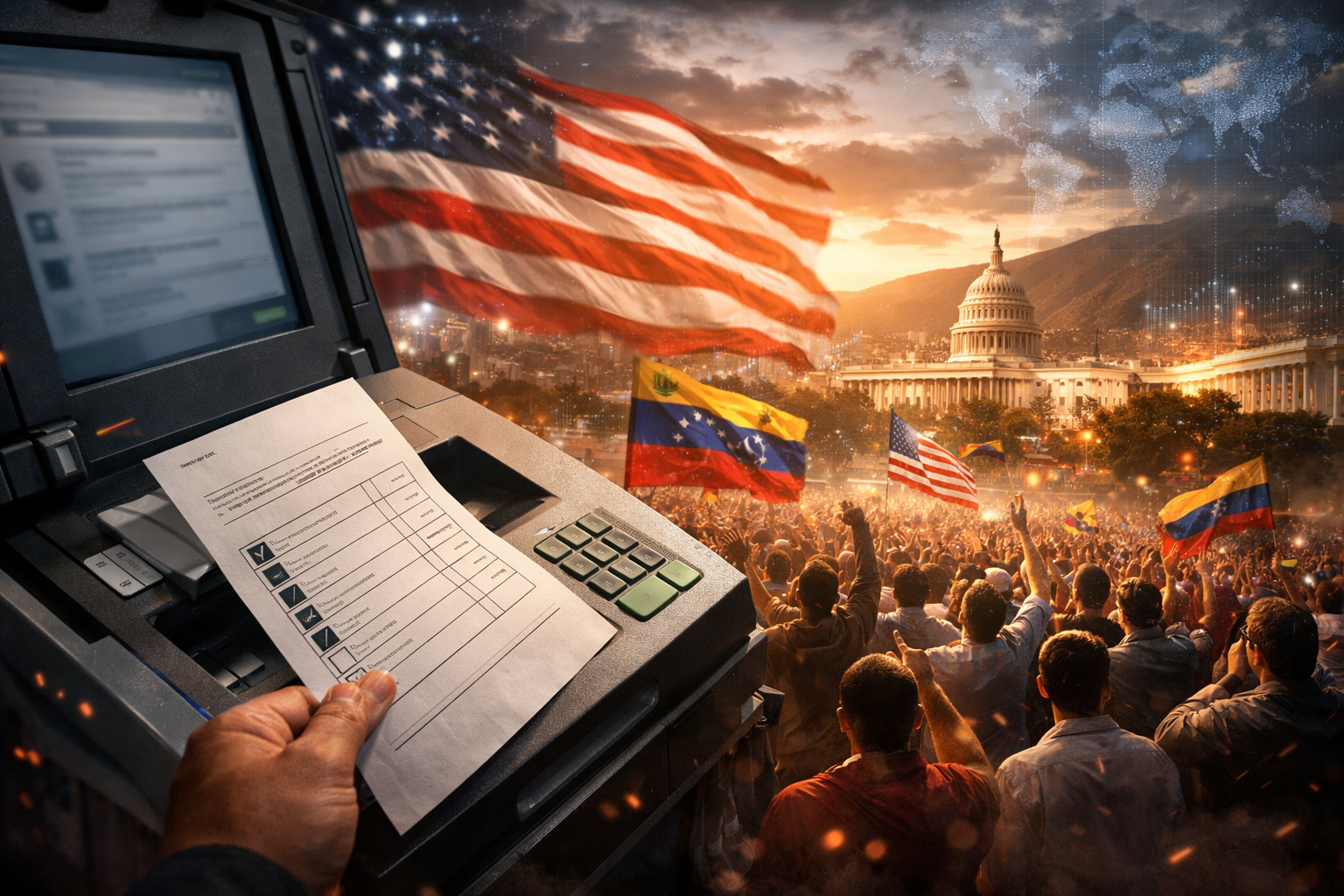
Venezuela isn’t being discussed as just another troubled nation. It’s being framed as something far bigger: an operational hub—a place where power, influence, and systems of control were allegedly refined, exported, and used to shape outcomes far beyond its borders.
The argument is simple: if you want to understand what’s happening now, you have to rewind.
The Warning Broadcast on CNN That Still Echoes Today
In 2006, CNN’s Lou Dobbs Tonight ran reports focused on something that struck at the heart of American sovereignty: who controls the tools that run elections.
Dobbs opened one segment with a blunt claim that the federal government had failed to address a threat to election integrity:
“New evidence that the federal government has ignored a threat to the integrity of our elections.” CNN Transcripts
CNN’s reporting described how Smartmatic—a company structured through international holdings and owned by Venezuelan businessmen—had bought Sequoia Voting Systems in 2005, and the sale was not reviewed at the time:
“When Smartmatic bought… Sequoia in 2005, the U.S. government did not review the sale.” CNN Transcripts
The concern wasn’t framed as partisan. It was framed as structural: private vendors + proprietary software + limited transparency creates an environment where wrongdoing could be hard to detect. One expert warned:
“The closed system… makes it extremely hard to find out what’s going on.” CNN Transcripts
And CNN continued returning to the theme repeatedly—calling foreign ownership of election infrastructure a direct danger to national security and democracy:
“The U.S. government did not review the sale… even though voting machines are critical to national security.” CNN Transcripts
By November 2006, Dobbs sharpened the warning again, telling viewers:
“Millions of Americans will be voting… on e-voting machines… owned… by nationals of a foreign government.” CNN Transcripts
In this framing, the CNN reporting wasn’t “just a story.” It was an early alarm—one that, critics argue, was never fully answered.
The Claim: Venezuela Was the Prototype—and the Export Model
The storyline then pushes beyond corporate ownership and into alleged operational intent:
Venezuela is presented as a testing ground for vote-manipulation systems.
Those systems are portrayed as exportable—sold, shipped, or deployed internationally.
The same architecture is then alleged to have been used wherever outcomes mattered.
CNN aired additional reporting that directly tied Smartmatic’s role in Venezuelan elections to broader concerns about integrity—quoting a claim of fraud and pointing to the Smartmatic system as central to the dispute. CNN Transcripts
Within this narrative, Venezuela becomes more than a country—it becomes a case study, then a template, then allegedly a distribution point.
The 2020 Explosion: Powell, Dominion, and the “Proof” Argument
The transcript you provided moves next to 2020, presenting Sidney Powell’s statements as confirmation of what CNN’s earlier warnings foreshadowed—arguing that election technology was “created” or proven in Venezuela and later used elsewhere.
From the same perspective, the U.S. election outcome is portrayed not as a domestic political event, but as the culmination of a long-running transnational project—installing preferred actors and advancing a broader agenda.
The “Whistleblower” Layer: Ballots, Printing, and Scale
Then comes the second reinforcement: a “military intelligence whistleblower” framing—claims about ballot anomalies, printing differences, and margins large enough to matter.
In this storyline, the goal of spotlighting specific ballot claims isn’t merely to litigate a single race. It’s to argue that once you accept the mechanism, you start seeing the same fingerprints everywhere.
The Final Frame: A Worldwide Counter-Operation Against Evil
The closing argument in your transcript is not political—it’s spiritual and civilizational:
A “White Hat” network is described as a high-level intelligence coalition of people who refused to “sell out” to evil.
Trump is cast as a spearhead figure in that coalition.
The objective is described as dismantling global headquarters of corruption—places portrayed as hubs of trafficking, criminal finance, and ideological control.
In that worldview, Venezuela is not just a dictatorship with narcotrafficking problems. It’s presented as an infrastructure node: election interference, drug flows, and influence operations—a strategic platform that must be removed for the world to breathe again.
And the emotional call to action is clear: don’t submit to despair, don’t accept the “evil always wins” narrative, and don’t let cynicism become your religion. The claim is that what’s unfolding is not collapse—it’s exposure, accountability, and the beginning of a reversal.
Why This Hits So Hard With People
Because it presents a single unified storyline:
Mainstream warnings appeared years ago (CNN’s reporting on foreign-linked voting infrastructure and the vulnerabilities of closed, proprietary systems). CNN Transcripts CNN Transcripts
Later allegations claim the mechanism scaled globally.
Today’s events are framed as the takedown phase.
Venezuela isn’t just a headline—Venezuela is the link.
Here’s the real-world risk to democracy—globally—when election systems (and the companies, code, people, and supply chains behind them) are not fully transparent, auditable, and sovereign-controlled.
The global risk to democracy
1) Elections stop being “accepted truth” and become “contested stories”
Democracy runs on losers accepting results because the process is trusted. When the systems are opaque—especially proprietary, closed, or vendor-controlled—people don’t have a clean way to verify outcomes, so every close election becomes combustible. CISA explicitly notes that cyber intrusions or weaknesses in election systems can diminish public confidence—confidence elected officials need to govern. CISA
Implication: legitimacy collapses first in the mind, then in the street—protests, refusal to concede, paralysis, and factionalism become normalized.
2) Supply-chain exposure becomes a national security vulnerability
Election infrastructure is part of a broader ecosystem: hardware parts, firmware, software updates, subcontractors, remote support, logistics, paper, storage, and chain-of-custody processes. That’s exactly why CISA calls securing the supply chains behind election infrastructure “mission critical” and frames supply-chain risk analysis as essential. CISA
Implication: foreign leverage doesn’t require “hacking on election night.” It can be introduced earlier—through vendors, dependencies, updates, components, or compromised processes.
3) “Black box” voting creates permanent suspicion—even when outcomes are correct
If the public can’t see how outcomes were produced, they fill the gap with suspicion. NIST has long emphasized the importance of auditability and software-independence concepts—so that software failures or manipulation can be detected and corrected through audits. NIST
Implication: you don’t just risk one election—you risk a permanent legitimacy crisis where every result is assumed fraudulent by half the country.
4) It invites strategic exploitation by hostile states and organized networks
Once systems are perceived as questionable, adversaries don’t have to “change votes” to win. They can:
amplify allegations,
seed doubt,
weaponize leaks (real or fake),
and push societies into internal conflict.
OSCE guidance on elections and ICT highlights that democratic elections require transparency and accountability, and that technology increases complexity and the stakes of trust. OSCE
Implication: a country can be destabilized simply by making its people believe the system is rigged—whether or not it is.
5) The legitimacy domino effect spreads across borders
Election practices, technologies, vendors, and narratives travel. If one influential country’s elections are widely disputed, it becomes a model—others copy the tactics, the rhetoric, and sometimes the weak controls. The European Commission’s work on e-voting notes the breadth of approaches and the complexity of electronic and internet voting environments across countries. European Commission
Implication: disputed elections become a global contagion—weakening alliances, increasing unrest, and empowering authoritarian messaging (“democracy is fake”).
6) Democracy becomes “managed”—not chosen—when verification is weak
The core issue isn’t “who wins.” It’s whether citizens can be confident that:
votes are cast as intended,
recorded as cast,
and counted as recorded.
The U.S. Election Assistance Commission’s VVSG 2.0 is built around precisely these principles of verifiability and voter confidence. U.S. Election Assistance Commission
Implication: if people believe outcomes are engineered, then voting becomes theater—participation drops, cynicism rises, and the system rots from the inside.
Why this matters more than ever
Because once trust is damaged, it’s extremely hard to rebuild. The Council of Europe warns directly that when public trust diminishes, regaining it is “exceedingly challenging,” and emphasizes transparency as a key element of confidence in e-enabled elections. Council of Europe
That’s the global bottom line: democracy doesn’t die only by coups. It also dies by doubt—when citizens no longer believe their voice counts.
What the strongest democracies do to reduce these risks
Paper-based audit trails and post-election audits (including risk-limiting audits) to prove outcomes match the ballots. NIST
Supply-chain controls (vendor vetting, component provenance, update integrity, contingency planning). CISA
Transparency measures so independent experts can evaluate systems and processes, even if not everyone can understand the technical details. Council of Europe
