
The “Digital Dragnet” Debate: How Palantir, Flock ALPR, and Dataminr Can Help Save Lives—and How They Can Also Track Everyone
Picture this:
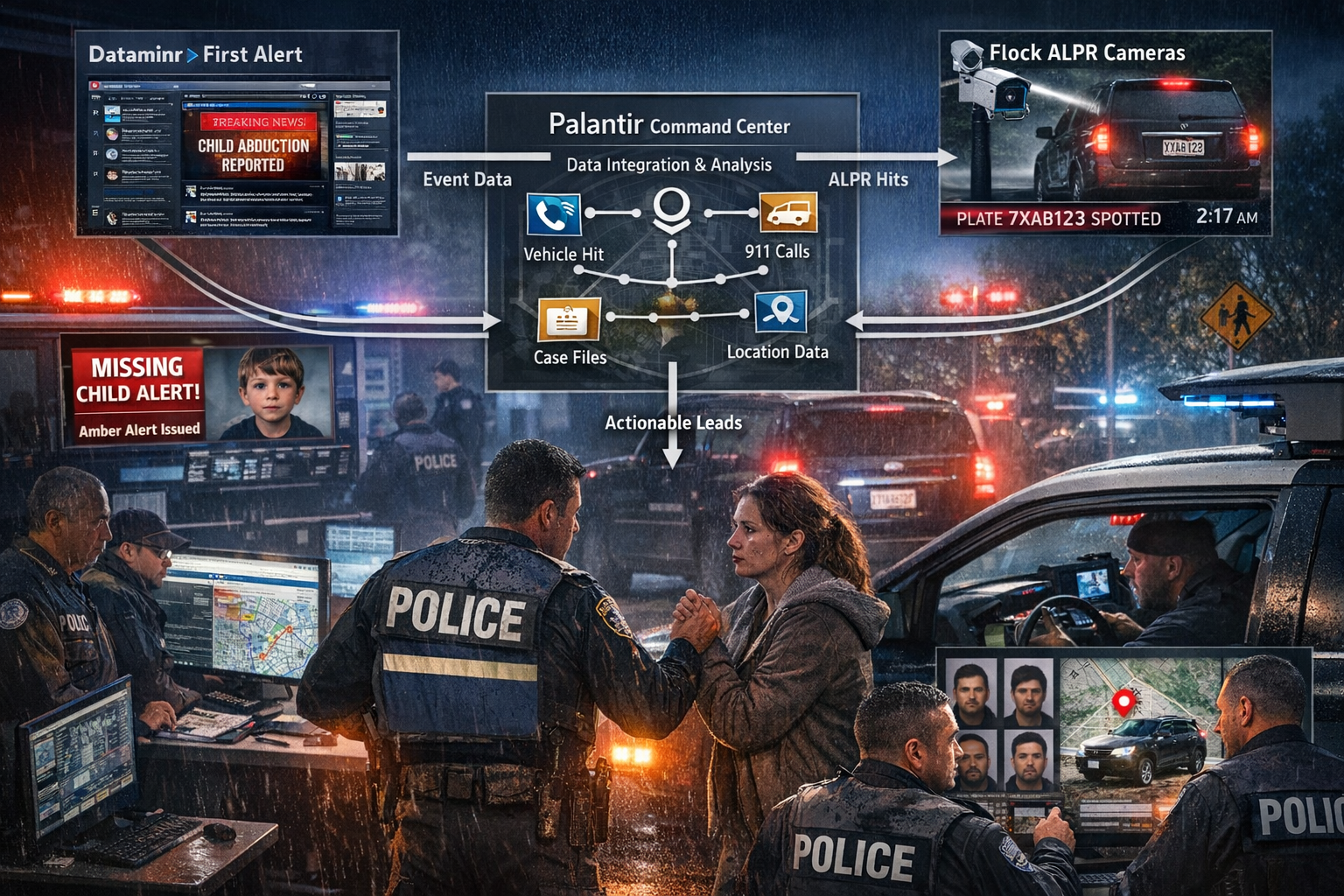
It’s 2:13 a.m. A 911 call comes in: a child is missing. The family can only say, “A dark SUV left fast.”
Within minutes, three kinds of technology can work together:
Dataminr First Alert helps emergency teams spot breaking events fast (from large volumes of public information and signals) so they can move sooner, not later. Dataminr
Flock Safety ALPR cameras capture license plates + time + location and can trigger alerts when a plate matches a “hot list.” Flock says LPR data is hard-deleted after 30 days by default (unless local law/policy sets something different). Flock Safety Flock Safety
Palantir-style “data fusion” platforms (what Palantir markets in Foundry/Gotham) can pull many systems into one view, track what staff are doing, and keep audit trails of actions inside the platform. Palantir
That is the promise: faster clues, faster coordination, faster outcomes.
Now the concern: the same stack can become a location-history machine—the kind that quietly builds a map of where everyday people drive, day after day.
A simple way to understand the “stack”
Think of public-safety tech like a team:
1) The Lookouts (Dataminr)
Dataminr First Alert is positioned as a real-time “what’s happening right now” alert tool for public sector and emergency management—helping agencies detect and respond to incidents earlier. Dataminr+1
Use case story: A wildfire starts moving fast. Dataminr alerts emergency managers early so they can push evacuation decisions sooner and line up resources. Dataminr
(And it can plug into mapping workflows—Esri has announced ArcGIS Basemaps integration into Dataminr First Alert.) Esri
2) The Street Cameras (Flock ALPR)
Flock cameras don’t “know your name.” They read plates (and capture vehicle images) so police can search and get alerts.
Flock says:
Data is stored in AWS GovCloud, Flock Safety
LPR data is hard deleted after 30 days by default, Flock Safety+1
And the retention window can be adjusted if local law/policy requires it. Flock Safety
Use case story: An elderly person with dementia is missing. A family shares the license plate. An ALPR hit shows the vehicle was just seen near a freeway on-ramp—search teams narrow the area and time window.
3) The “Brain and Clipboard” (Palantir / data fusion + workflows)
Palantir’s platforms are often described as tools that combine data from many sources and help teams act on it. Palantir also emphasizes audit logs (a record of actions inside the platform) and describes AIP as providing security/governance features like access controls and auditing. Palantir
Use case story: A regional task force is dealing with a robbery crew. A fusion platform pulls together:
case reports,
known associates,
vehicle sightings (including ALPR hits),
and timelines.
Then supervisors assign tasks, document decisions, and track follow-ups.
Where the privacy alarms start ringing
Critics don’t usually say, “ALPR can never help.” They say:
Concern 1: “It tracks innocent people too.”
An ALPR system doesn’t only read plates of suspects. It reads every car that passes—which can create location trails that reveal sensitive patterns (doctor visits, places of worship, political events). Policy researchers warn that ALPR raises civil-liberties concerns and that rules vary widely. Brennan Center for Justice
Concern 2: Sharing can turn local cameras into a wider net
This is one of the biggest public controversies: who gets access and how sharing works.
Recent reporting and public debate have focused on fears that ALPR data can be shared with federal agencies (including immigration enforcement), and whether local safeguards are strong enough. KTVU FOX 2 San Francisco San Francisco Chronicle CT Insider
Flock has publicly said it removed federal agencies from certain lookup features and that sharing is controlled by agencies (and can be revoked). Flock Safety
Concern 3: “Mission creep” happens
Even if a city buys ALPR “for auto theft,” people worry it will slowly expand:
from serious crimes → minor offenses,
from active investigations → broad searches,
from short retention → longer retention,
from limited access → wider access.
That’s why you see pushback at city councils (including in San Diego) asking for alternatives or tighter limits. Axios
Concern 4: Social/public-data monitoring can chill speech
Dataminr is marketed as public-sector real-time event discovery. Dataminr
But civil-liberties groups have long warned that social media monitoring—especially keyword/hashtag-based alerting—can sweep in innocent people and discourage lawful speech. American Civil Liberties Union ACLU of Norcal
Concern 5: The “one platform to rule them all” effect
Here’s the key idea: each tool alone is limited. But when you connect them, the system becomes more powerful.
Dataminr helps teams notice events faster.
Flock helps answer “where was that car seen?”
A fusion platform helps connect sightings + people + places + timelines + actions.
That’s great for urgent cases. It’s scary if oversight is weak—because the same setup can become a mass location database.
Real-world friction points people are arguing about right now
These debates aren’t abstract.
Oakland: The city renewed a large Flock deal amid concerns about access and potential federal sharing. San Francisco Chronicle
Connecticut: The ACLU pushed for a halt/moratorium until stronger privacy laws exist. CT Insider
Texas: Reporting says Texas authorities investigated licensing issues connected to Flock’s operations. Houston Chronicle
San Diego: Local leaders publicly urged exploring alternatives and tightening the approach. Axios
What “responsible use” looks like (in plain terms)
If a city uses this stack, strong privacy protections usually mean:
Narrow rules: written limits on what the tech can be used for (serious crimes, missing persons), and what it cannot (protected speech/activity without strict legal standards). Brennan Center for Justice
Short retention that cannot quietly expand: default deletion backed by policy, contracts, and audits (not “trust us”). Flock Safety
Tight access: fewer users, strong authentication, role-based permissions.
Audit logs reviewed in real life: not just “we have logs,” but routine checks for misuse (Palantir highlights audit logs as a core security control in Foundry). Palantir
Clear sharing limits: who can share with whom, how it’s approved, and public reporting. San Francisco Chronicle
Independent oversight: privacy impact assessments, public meetings, and consequences for misuse.
Bottom line
This technology stack can absolutely support real wins: missing-person recoveries, faster disaster response, quicker identification of stolen vehicles.
But privacy advocates see a different story: a world where every drive becomes a data point, and where data-sharing and fusion make it too easy to track people who did nothing wrong.
Whether it becomes “public safety” or “digital dragnet” depends less on the software—and more on policy, limits, transparency, and enforcement.
References
Axios. (2025, December 12). San Diego leaders push police to seek alternatives to Flock for surveillance. Axios
Brennan Center for Justice. (2020, September 10). Automatic license plate readers: Legal status and policy recommendations. Brennan Center for Justice
CalMatters. (2025, June 13). California police illegally share license plate reader data to federal agencies. CalMatters
Connecticut Insider. (2025, November 11). ACLU demands Connecticut halt license plate reader use over privacy concerns. CT Insider
Dataminr. (n.d.). Dataminr First Alert. Dataminr
Esri. (2025, July 14). Esri’s ArcGIS Basemaps power Dataminr First Alert for enhanced real-time event detection and awareness. Esri
Flock Safety. (2025, July 22). Flock Evidence Policy. Flock Safety
Flock Safety. (2025, November 13). License Plate Reader (LPR) Policy. Flock Safety
Flock Safety. (2025, October 22). Statement in response to recent reports. Flock Safety
Houston Chronicle. (2025, December 18). Texas investigating Flock Safety over claims it operated without a license. Houston Chronicle
KPBS. (2025, November 20). San Diego County police agencies access many private license plate readers with minimal oversight. KPBS Public Media
Palantir Technologies. (2025, November 13). Security auditing: Audit logs overview. Palantir
Palantir Technologies. (n.d.). AIP overview. Palantir
San Francisco Chronicle. (2025, December 17). Oakland renews $2 million Flock license plate camera deal amid ICE data concerns. San Francisco Chronicle
ACLU. (2016, May 6). Why government use of social media monitoring software matters. American Civil Liberties Union
ACLU. (2016, December 15). Twitter cuts off fusion spy centers’ access to social media data. American Civil Liberties Union
