

Chile, Bulgaria, Honduras: how voters globally are shifting away from socialist-led governance
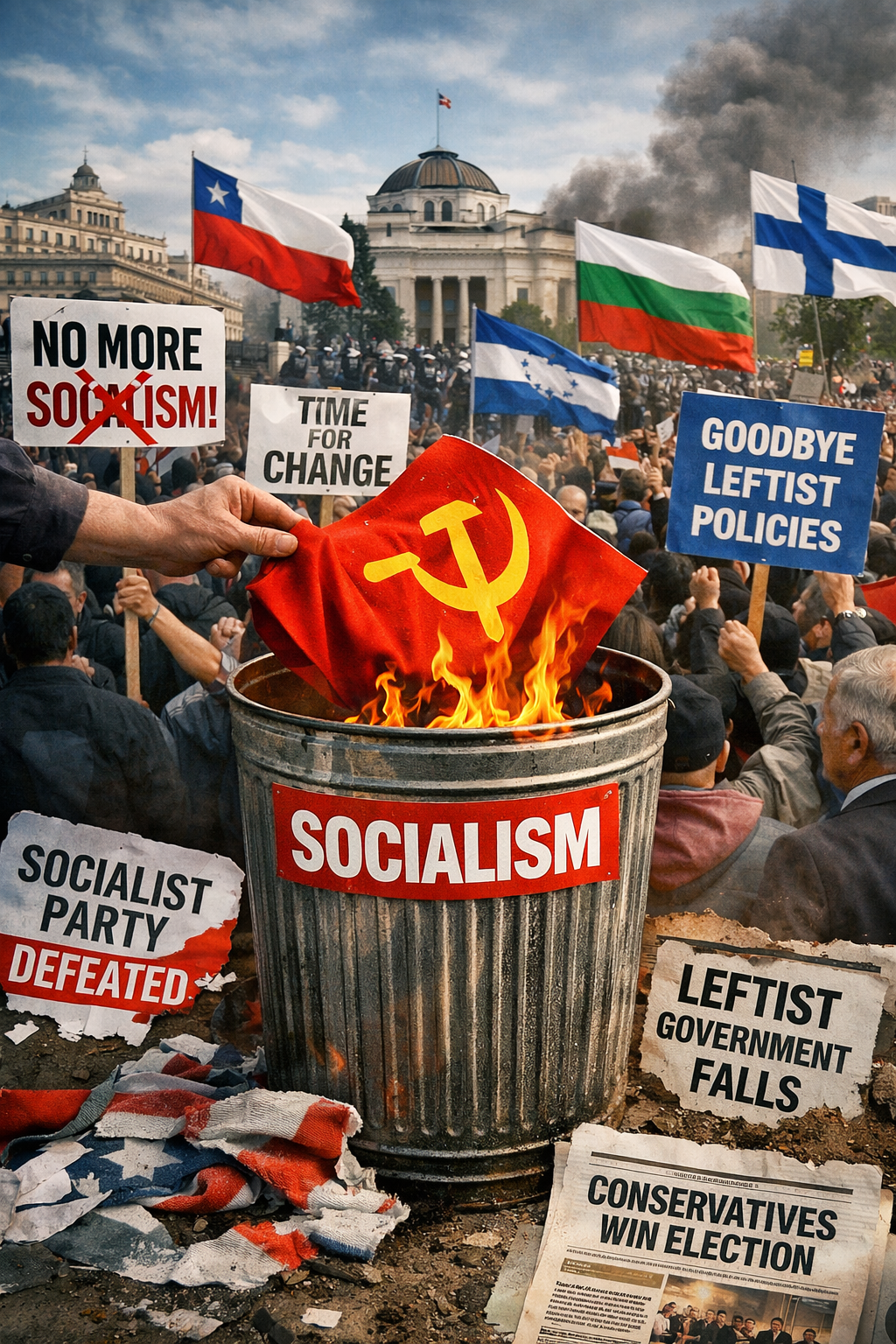
A growing public backlash: “Stop trying to run our lives, rewrite our identity, and police our beliefs”
Across multiple democracies, elections and street protests are increasingly shaped by a single, consistent demand: limits on government power.
In country after country, large segments of the public are signaling that they are tired of:
expanding state control (taxation, spending, regulation, bureaucracy),
top-down speech and information enforcement, and
political projects that treat national identity, tradition, and faith as something to be managed, softened, or replaced.
This isn’t presented by voters as an abstract theory. It is expressed as a practical refusal: “You don’t get to force us into one approved worldview.” That mood is now driving real political outcomes.
Chile: the electorate chose a hard break from the left’s governing direction
Chile is a direct example of voters moving away from the governing left and installing a leader explicitly framed as a corrective.
Reuters reported that on December 14, 2025, Chile elected José Antonio Kast president with 58% in a “sharp rightward shift,” defeating government-backed left candidate Jeannette Jara (42%). Reuters
The election was widely tied to public demand for:
security and order,
tougher immigration posture, and
reductions in public spending and state expansion—all central themes in coverage of Kast’s platform and voter mood. Reuters
Chile also experienced years of institutional turmoil around constitutional change, with voters repeatedly rejecting sweeping rewrites—an indicator of an electorate unwilling to accept large-scale political remaking of the country. Reuters
Result: Chile’s vote functioned as an unmistakable public statement: move away from the left’s project; restore order; stop the social engineering; reduce the state’s footprint. Reuters
Bulgaria: protests and resignation over taxes, spending, and corruption
Bulgaria shows the same “enough is enough” pressure—expressed through mass protest rather than a single ideological election headline.
Reuters reported Bulgaria’s government resigned in December 2025 after weeks of protests over economic policy and a perceived failure to tackle corruption. Reuters
Reuters also reported protesters and opposition groups pointed specifically to plans to raise social security contributions and tax dividends to finance higher state spending. Reuters
Result: a visible public revolt against the combination of higher state demands + low public trust—a rejection of being told to pay more into a system widely perceived as unaccountable. Reuters
Honduras: the left lost power in a contested election—another “throw them out” outcome
Honduras is another case where the ruling left did not hold power.
Reuters reported that conservative National Party candidate Nasry Asfura was declared the winner of Honduras’ Nov. 30, 2025 election after weeks of delays and disputes, while the ruling leftist LIBRE party’s candidate trailed. Reuters
AP similarly described the outcome as a blow to the ruling left and a shift in direction. AP News
Result: another national electorate sending the message that the current governing model—associated with the ruling left—has not earned continued authority. Reuters
Australia: why analysts see “heavy-hand risk” rising for the Prime Minister
Australia is a key example of the same global tension: public tolerance for state power has limits, especially when government is perceived as pushing control over speech, protest, or values.
1) Public backlash against “speech control” efforts
Australia’s proposed misinformation/disinformation crackdown became a national flashpoint. Reuters reported the government proposed major fines on platforms for misinformation compliance—drawing anger from free speech advocates. Reuters
Reuters later reported the government dropped the plan. Reuters
Australian media and parliamentary documentation showed the bill aimed to impose stronger controls over “harmful misinformation and disinformation,” becoming a focal point for public distrust of “truth policing.” Parliament of Australia
2) Public order powers can trigger backlash
In December 2025 reporting, Australia saw heightened debate over expanded police powers and protest restrictions after the Bondi attack, including temporary bans on protests in designated areas. News.com.au
These kinds of steps—regardless of government justification—often become exactly the issue that catalyzes “heavy hand” narratives.
3) Polling shows political vulnerability and tightening margins
A mid-December 2025 Roy Morgan poll reported Labor’s two-party preferred lead narrowing to its closest since the May 2025 election, alongside falling primary support. Roy Morgan
Major Australian outlets also reported the Prime Minister facing a more difficult political landscape and growing scrutiny of leadership performance during national security and governance controversies. The Guardian
The Guardian quoted analysis that crisis comparisons between leaders can harden voter perceptions quickly—“what has been seen by voters can’t be unseen.” The Guardian
Result: Australia is increasingly being discussed through the same lens seen elsewhere—if government is viewed as controlling, moralizing, or coercive, and simultaneously failing on safety and cost-of-living, public patience erodes fast. Reuters The Guardian
The trend, stated plainly
Recent elections and protests in Chile, Bulgaria, Honduras—and growing debate in Australia—fit one expanding pattern:
Large parts of the public are rejecting government projects that feel like control systems—systems that tell people what to accept, what to say, what to believe, and how to define their identity. When citizens feel their culture and faith are treated as obstacles rather than foundations, politics stops being “left vs. right” and becomes people vs. the state.
And when that line is crossed, the public response is increasingly direct: vote them out, protest them out, or force a reversal.
