

Burma's Future Cannot Be Built by Leaving Ethnic Nations Behind
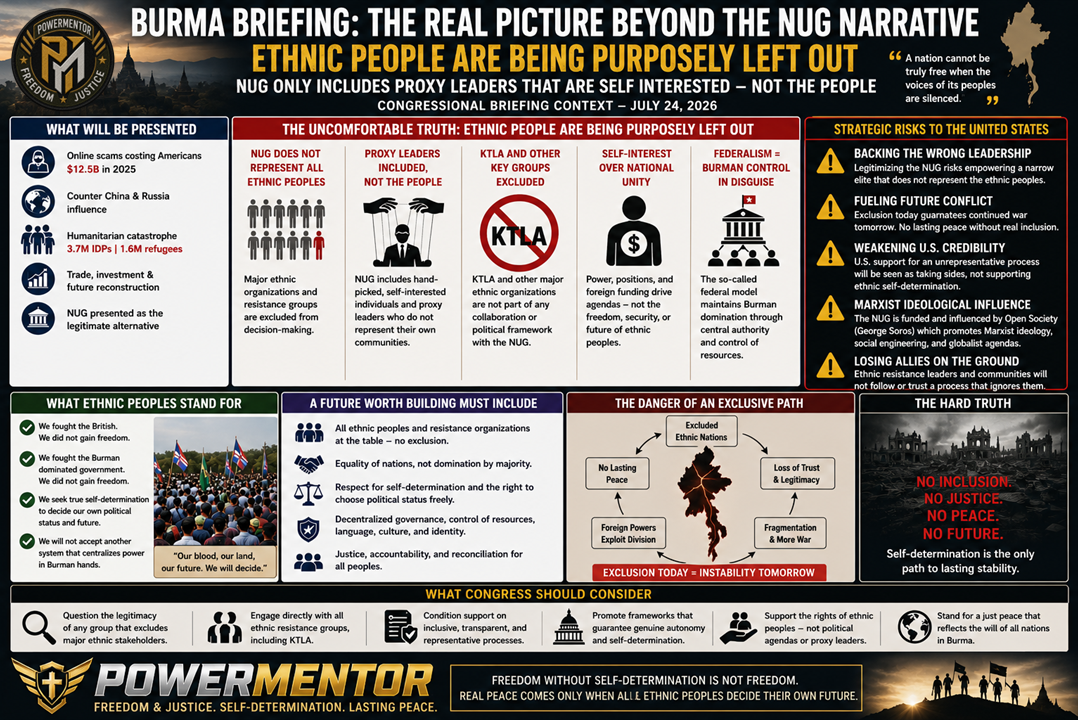
As policymakers gather in Washington to discuss Burma's future, one question deserves far more attention than it is receiving:
Who is not at the table?
The congressional briefing appropriately highlights online scam compounds, humanitarian suffering, regional security, and the growing influence of China and Russia. These are serious issues. However, lasting peace in Burma will ultimately depend on whether a future political settlement is viewed as legitimate by the country's diverse ethnic nationalities—not merely by international observers or political elites.
For many ethnic communities, this remains an unresolved question.
Representation Matters
The National Unity Government (NUG) has received international attention as a leading political alternative to the military regime. At the same time, some ethnic organizations and community leaders argue that the current political process does not adequately reflect the full diversity of Burma's ethnic resistance movements or long-standing aspirations for self-determination.
Critics contend that meaningful participation requires more than consultation. They argue that organizations with substantial constituencies and operational roles on the ground should have an authentic voice in shaping Burma's future political framework.
From this perspective, questions remain about whether current decision-making structures are sufficiently inclusive.
The Debate Is Bigger Than Federalism
The discussion is often framed as a choice between military rule and a federal democratic union.
Many ethnic communities view the issue differently.
For them, the central question is not simply whether Burma adopts a federal system, but whether any future constitution genuinely protects local governance, political authority, cultural identity, security, and control over natural resources.
Different ethnic organizations advocate different constitutional models, ranging from stronger federal autonomy to confederal arrangements or other forms of self-determination through independence. These differences should not be overlooked in pursuit of a single national narrative.
Inclusion Is a Strategic Requirement
History demonstrates that peace agreements lacking broad participation are difficult to sustain.
If influential political or resistance organizations believe they have been marginalized, the risks include:
Reduced confidence in transitional institutions.
Competing political structures.
Fragmentation among resistance movements.
Delayed reconciliation.
Continued instability after the conflict.
These are not merely political concerns—they are strategic risks that could affect long-term regional stability.
Questions Policymakers Should Ask
Before endorsing any long-term political roadmap, policymakers should consider:
Which ethnic organizations are participating in constitutional discussions?
Which organizations are not participating, and why?
How will disagreements over governance be resolved?
What safeguards will prevent domination by any single political bloc?
How will local autonomy and self-governance be protected?
These questions are essential for evaluating the durability and legitimacy of any future settlement.
The PowerMentor Perspective
Peace cannot be imposed through exclusion.
Justice cannot be achieved if major stakeholders believe their voices are absent from the process.
Support for Burma should focus on principles rather than personalities: inclusive governance, accountability, equal participation, respect for ethnic diversity, and genuine self-determination.
A stable and prosperous Burma will require more than replacing one governing structure with another. It will require a political process that earns legitimacy across all of the country's peoples.
Real peace is built on representation. Lasting stability is built on inclusion.
Additional reading:
