

A War Fought on Two Fronts: How Ukraine’s Deep-Rooted Corruption Collides With a $100 Billion Flood of Western Aid
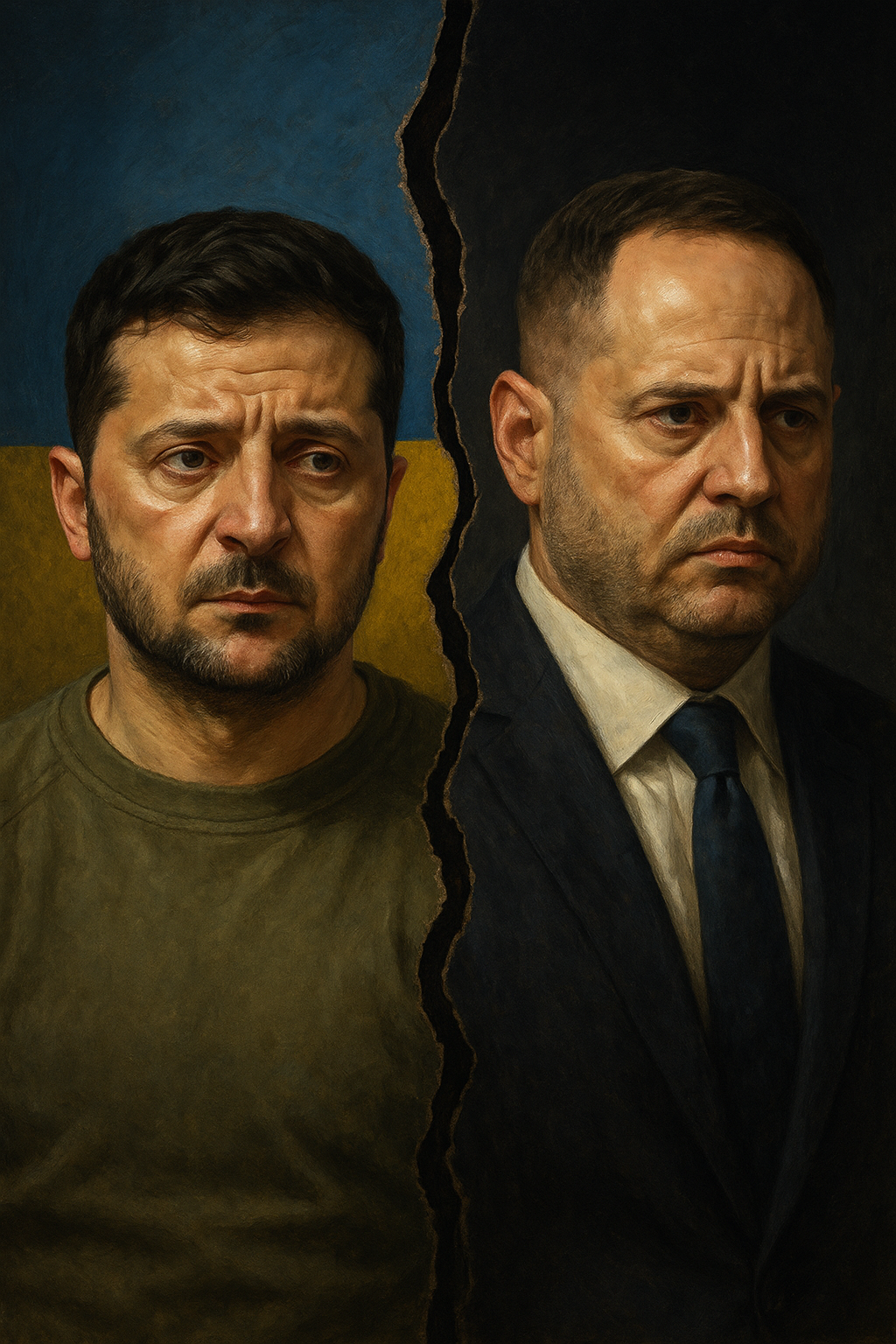
1. A New Scandal That Exposes an Old Problem
The resignation of Andriy Yermak, President Volodymyr Zelenskyy’s powerful chief of staff and widely seen as his “right-hand man,” after a raid by Ukraine’s anti-corruption police is more than a personnel change. It is the latest shockwave in a $100 million kickback scheme centered on Energoatom, Ukraine’s state nuclear energy company, uncovered by the National Anti-Corruption Bureau of Ukraine (NABU) in “Operation Midas.” Reuters Al Jazeera
Investigators allege that private companies were forced to pay 10–15% kickbacks to politically connected “overseers” simply to keep contracts and get paid, with illicit funds laundered through a web of shell firms and intermediaries tied to figures close to the presidential circle. Al Jazeera Carnegie Endowment
Eight suspects have already been charged, including a businessman described as the mastermind, while Ukraine’s justice and energy ministers have resigned amid public outrage. The Washington Post Al Jazeera
Yermak insists he is innocent and has not been formally charged, but the optics are devastating: the president’s closest aide has stepped down in the middle of war because anti-corruption officers showed up at his door. Reuters+1
This is not an isolated incident. It is a symptom of a deeper structural reality:
Ukraine has been “plagued by corruption” since gaining independence, and every president has promised to fight it—only to be consumed by it. AP News WTOP News
2. A System Built on Deals: Corruption Since Independence
From the early 1990s, Ukraine’s transition from Soviet republic to market economy was captured by a small circle of oligarchs who acquired state assets at fire-sale prices and then used that wealth to dominate politics. Carnegie Endowment Eurasianet
Key features of that system:
Privatization as plunder – strategic assets in energy, metals, and media were transferred to politically connected insiders in opaque auctions or “loans-for-shares” style deals.
Gas and energy as the beating heart of graft – subsidies, dual pricing, and quasi-state intermediaries created enormous arbitrage opportunities; control of gas flows meant control of cash and influence. Carnegie Endowment
Oligarchs as kingmakers – business barons bankrolled parties, controlled TV channels, and effectively rented the state to defend their own interests. Wikipedia
By the late 1990s and 2000s, international surveys consistently listed Ukraine among the most corrupt countries in Europe:
In 1998, Transparency International’s Corruption Perceptions Index (CPI) ranked Ukraine 69th of 85 countries, with a score of 2.8 out of 10—firmly in the “highly corrupt” band.
By 2004, Ukraine had slipped to 122nd of 146, with a score of 2.2, placing it near the bottom globally. Wikipedia
These are not just abstract numbers. They reflect a regime in which public office became a business model. Judges, customs officials, tax inspectors, police, and ministers operated within informal pay-to-play systems. The message to citizens was clear:
The state does not protect you; it sells access to protection.
Decades later, that legacy still shapes Ukraine’s institutions—even as new leaders promise change.
3. Corruption in the Numbers: Progress, But From a Very Low Base
Under Zelenskyy, and especially since the full-scale Russian invasion in 2022, Ukraine has built stronger anti-corruption institutions:
NABU (National Anti-Corruption Bureau)
SAPO (Specialized Anti-Corruption Prosecutor’s Office)
A new High Anti-Corruption Court
Transparency International notes that Ukraine’s CPI score has slowly improved for over a decade, reaching 36/100 in 2023 and 35/100 in 2024, ranking around 105th of 180 countries—better than it used to be, but still clearly in the “serious corruption” category. Wikipedia
In other words:
Ukraine is less corrupt than it was 20 years ago,
but still much more corrupt than the average European state, and
its own anti-corruption agencies keep uncovering massive new scandals, proving how deeply entrenched the problem remains.
The Energoatom affair is precisely one of those scandals. It sits at the crossroads of energy, oligarchic networks, and political power—the very sectors where Ukraine’s corruption has historically been most intense. The Guardian
4. A Flood of Western Money Into a Leaky System
Since 2022, the United States and European allies have poured well over $100 billion in military, economic, and humanitarian support into Ukraine, alongside significant pledges from other partners. Government Accountability Office
This support has been vital for Ukraine’s survival. But it has also collided with the reality that:
Western money is flowing into a system that has been structurally corrupt for three decades.
Two aspects are often conflated but should be distinguished:
(a) Oversight Failures on the Western Side
U.S. watchdogs have repeatedly documented serious problems tracking what has been sent, where it is, and how it has been recorded:
A Pentagon Inspector General report in early 2024 found that more than $1 billion in “sensitive” U.S. military equipment delivered to Ukraine had not been properly tracked in U.S. systems, calling into question prior claims of rigorous accountability (though it did not prove theft or diversion). AP News
A Government Accountability Office (GAO) review showed the Defense Department mis-valued defense articles sent under drawdown authority by about $6.2 billion, later revised to $8.2 billion, due to using replacement value instead of depreciated value—effectively creating billions in accounting discrepancies that obscured the true scale of aid. Government Accountability Office
Another GAO report found inconsistent and incomplete tracking of weapons deliveries across U.S. military branches, making it “impossible to accurately verify” how much of certain aid streams actually reached Ukraine and increasing the risk of loss or illicit transfer. New York Post
In strict audit terms, significant portions of U.S. aid have not been fully accounted for in official systems, even if investigators have not yet documented large-scale diversion.
(b) A High-Risk Environment on the Ukrainian Side
At the same time, Ukraine’s own record heightens the risk that poorly tracked resources could be misused:
International and Ukrainian media routinely describe the country as “plagued by corruption since independence,” a phrase repeated in recent coverage of the Energoatom scandal. AP News WTOP News
The current $100 million Energoatom case shows that even during full-scale war, networks within the state were allegedly siphoning off funds that could have supported defense or basic services. The Guardian Carnegie Endowment
This collision of massive inflows and weak governance creates three dangerous perceptions:
For Ukrainian citizens: that their sacrifices at the front are being betrayed by thieves in suits.
For Western taxpayers: that they are funding a war and an elite lifestyle at the same time.
For Russia and its propaganda machine: that it can label Ukraine not as a victim, but as a corrupt client state undeserving of support.
Perception is not the same as proof—but in politics, perception alone can shift policy.
5. How Corruption Undermines Ukraine’s Stability and War Effort
The Energoatom–Yermak scandal is not just about enrichment. It has direct implications for Ukraine’s stability at a moment when the country is fighting for survival.
(a) Corruption Is a Direct Security Threat
Ukrainian analysts themselves have warned that theft of wartime funds is equivalent to “stealing drones and ammunition”—a direct hit on defense capability. Espreso
Every diverted dollar means:
fewer shells and drones,
weaker air defense,
and longer, bloodier battles at the front.
In this sense, corruption is not a side issue—it is a second front in the war.
(b) Erosion of Public Trust and Elite Infighting
When citizens see ministers, business partners, and now the president’s chief of staff dragged into scandals, trust collapses:
Public anger has already forced the resignation of Ukraine’s defense minister in 2023 over procurement scandals, and more recently, the justice and energy ministers over the Energoatom case. The Washington Post Al Jazeera
Yermak’s fall rips open long-standing elite power struggles inside Kyiv. He was the gatekeeper: losing him means factions will compete bitterly to fill the vacuum, at exactly the moment Ukraine needs unity. Reuters The Independent
A state fighting for survival cannot afford a permanent war inside its own political class.
(c) Damage to EU Accession and Long-Term Reconstruction
The European Union has made serious, measurable anti-corruption progress a precondition for full membership. The Energoatom scandal and the Yermak resignation:
reinforce arguments by skeptical EU members that Ukraine is “not ready”,
endanger support for large-scale reconstruction funds,
and give ammunition to governments already reluctant to move forward with enlargement. The Guardian RadioFreeEurope/RadioLiberty
In short, corruption directly threatens Ukraine’s European future.
6. What This Means for Western Policy
The West now faces a hard reality:
Billions in aid are being sent to a country that is simultaneously fighting Russia and fighting itself.
Three implications stand out.
1. Conditionality Is No Longer Optional
Western governments will increasingly tie aid to concrete anti-corruption benchmarks:
full empowerment and protection of NABU, SAPO, and the Anti-Corruption Court;
transparent, internationally supervised audits of key state sectors (especially energy, defense procurement, and reconstruction);
prosecution—not just resignation—of high-level officials when evidence warrants it. The Guardian RadioFreeEurope/RadioLiberty
Without visible accountability at the very top, political support for Ukraine in Washington, Brussels, and European capitals will erode.
2. More Money Will Be Routed Around the Ukrainian State
To reduce risk, donors are likely to:
channel funds through multilateral institutions, trust funds, and NGO-managed projects,
keep certain procurement under NATO, EU, or U.S. direct control,
and use end-use monitoring teams, digital tracking, and on-the-ground auditors more aggressively. Government Accountability Office Office of Inspector General
This protects taxpayers—but it also limits Ukraine’s sovereignty over its own recovery, reinforcing the impression that it cannot be trusted with its own money.
3. Ukraine Must Treat Corruption as a Wartime Enemy
If Ukraine wants to maintain foreign support and stabilize its own society, corruption has to be treated as seriously as Russian tanks:
high-profile cases must lead to transparent trials and real sentences,
political “untouchables” must lose their immunity,
and citizens must see that the law can reach the president’s friends as easily as it reaches small officials.
The removal of Yermak—whether seen as a genuine cleansing or a political sacrifice—creates a narrow window. If it is followed by serious prosecutions, structural reforms, and a public break with oligarchic networks, Ukraine can argue that this scandal proves its commitment to change. If not, it will look like the old story in new packaging.
7. Conclusion: Two Battles, One Outcome
Ukraine today is fighting a visible enemy in Russian aggression and an internal enemy in systemic corruption. The Energoatom scandal and the fall of the president’s chief of staff have torn away the veneer of wartime unity and reminded the world that:
this is a country with a three-decade track record of deep corruption,
now entrusted with vast sums of Western money,
in a moment when Western patience and resources are not infinite.
Whether Ukraine emerges from this crisis as a reformed, accountable state or as another cautionary tale of a captured system propped up by foreign cash will depend on what happens next: not just on the battlefield, but in the courts, ministries, and boardrooms where public money is decided, and too often, stolen.
References
Associated Press. (2024, January 11). US failed to track more than $1 billion in military gear given Ukraine, Pentagon watchdog says. AP News
Carnegie Endowment for International Peace. (2012, March 9). The underachiever: Ukraine’s economy since 1991. Carnegie Endowment
Eurasianet. (2020, May 14). A brief history of corruption in Ukraine: The Kravchuk era. Eurasianet
Government Accountability Office. (2024, July 22). Ukraine assistance: Actions needed to properly value defense articles provided under presidential drawdown authority (GAO-24-106934). Government Accountability Office
Government Accountability Office. (2025, March 15). Pentagon can’t guarantee accurate tracking of Ukraine aid, watchdog finds. New York Post
Reuters. (2025, November 28). Ukraine’s top peace negotiator quits after raid by anti-graft police. Reuters
RFE/RL. (2025, November 18). Ukraine’s Energoatom corruption scandal and the future of reform. Carnegie Endowment
Transparency International. (2024). Corruption in Ukraine. In Corruption Perceptions Index 2024. Wikipedia
U.S. Department of Defense, Office of Inspector General. (2024, June 26). Evaluation of the DoD’s accountability of lost or destroyed defense articles designated for enhanced end-use monitoring. DoDIG
WTOP / PBS / Boston Globe (various). (2025, November). Coverage of Ukraine’s $100 million Energoatom corruption scandal and ministerial resignations. BostonGlobe.com The Washington Post AP News
