

Venezuela’s Transition Trap: Why an Opposition Takeover Could Turn Into a National Meltdown
A reported CIA assessment, described by The Wall Street Journal, warns that Venezuela’s opposition would face major difficulty running a temporary government—and that top figures already inside the regime’s governing structure are “best placed” to lead in the immediate aftermath of Maduro’s removal. Wall Street Journal
That assessment hits as Venezuela enters a high-risk phase: the old system is still armed, still organized, and now openly framing events as “imperial aggression,” while the opposition is being pushed to claim authority without controlling the machinery of the state.
The core problem: you can’t govern what you don’t control
Even if the opposition is recognized internationally or has popular momentum, governing requires instant command of security forces, ministries, courts, ports, fuel distribution, and the national payroll. The intelligence warning—opposition struggles, insiders best positioned—reflects a hard reality: the regime’s institutional spine doesn’t disappear just because Maduro is gone. Wall Street Journal
Retaliation is already underway against anyone seen as pro-U.S.
This is the most explosive accelerant—and it directly targets “anyone supporting U.S. interests.”
Reuters reports that a state-of-emergency decree orders Venezuelan police to find and arrest anyone involved in the “promotion or support” of the U.S. attack, with the decree published publicly on January 5. Reuters
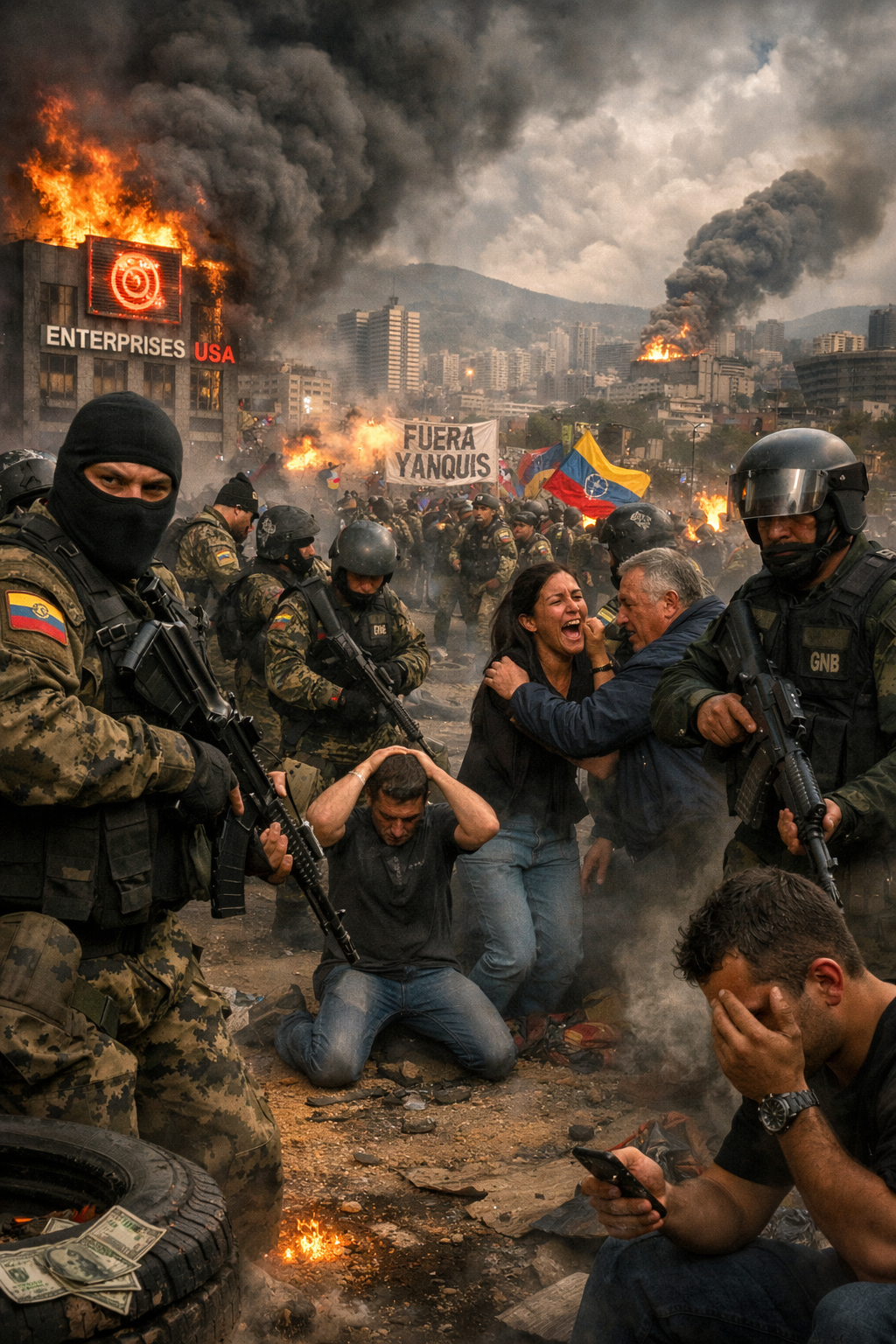
The Financial Times describes a broader repression wave aimed at crushing celebration, dissent, and collaboration narratives: armed pro-regime colectivos deployed in opposition neighborhoods, journalists detained, media access tightened, and phone monitoring for pro-U.S. sentiment. Financial Times
This retaliation campaign matters because it means an opposition “takeover” wouldn’t just be a political transition—it would be a counterinsurgency-style hunt for networks, organizers, and public supporters tied (fairly or unfairly) to U.S. objectives.
Important accuracy point: your brief mentions possible executions. The major reporting I’m seeing today clearly supports arrests and an expanding crackdown; it does not clearly confirm an official execution policy in the decree itself. Reuters
Why an opposition takeover could get ugly fast
If the opposition tries to step into power while the regime’s security state remains intact, several destabilizing dynamics can collide:
The regime keeps the handcuffs.
The opposition may be “in charge” on paper, but without command of police, military, and intelligence, it cannot protect supporters—or enforce decisions.Fear collapses civic life.
When people believe they can be arrested for “support” or “promotion,” they stop organizing, stop speaking, and stop cooperating—exactly when a transitional government needs maximum public participation. ReutersInternal fractures become inevitable.
Opposition coalitions often include moderates (stability/negotiation) and hardliners (rapid purge/accountability). Under pressure and infiltration risk, unity can break—slowing decisions when speed is survival.The economy becomes the opposition’s immediate crisis.
Fuel distribution, food supply, currency stability, and public services don’t pause for politics. Any disruption—especially amid repression and contested legitimacy—turns hope into anger and creates openings for hardliners to justify greater force.
The “transition” risks becoming a trap
Put plainly: an opposition takeover can fail not because the opposition lacks ideas, but because it inherits responsibility without real control, while the remaining regime apparatus uses “anti-imperial” justification to retaliate against anyone tied to U.S. interests. That is exactly the kind of scenario the reported intelligence warning appears to anticipate. Wall Street Journal Reuters
What would reduce the blood-pressure—and the bloodshed—risk
If Venezuela is to avoid collapse, the transition needs (at minimum):
Immediate constraints on security forces and colectivos plus verifiable protections for civilians and press. Financial Times
A unified, time-bound electoral roadmap with credible oversight.
A transitional structure that combines legitimacy with operational control (technocratic governance, continuity in essential services, and security guarantees that prevent both impunity and indiscriminate purges).
Right now, the trajectory described by Reuters and the FT points the other way: toward a tightening dragnet against perceived collaborators and a climate of intimidation—conditions that can turn an opposition “victory” into a national crisis. Reuters
