

Schumer’s Venezuela Whiplash: When the Standard Changes, Credibility Collapses
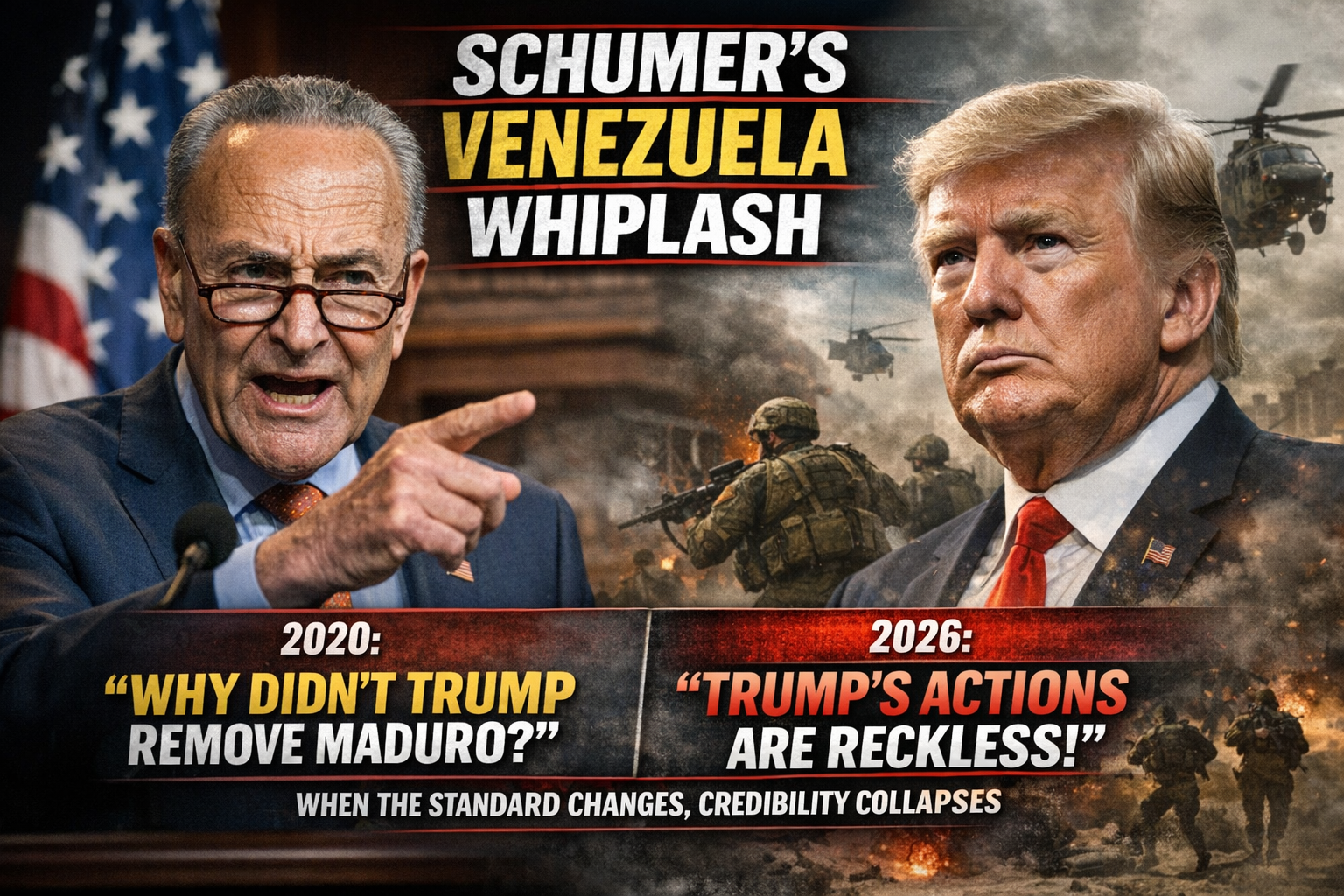
Washington politics has a tell: when a leader’s “principles” shift depending on whether the outcome helps or hurts the other side, the public isn’t watching policy anymore—it’s watching positioning. Senator Chuck Schumer’s record on Venezuela is a case study in that credibility problem.
In February 2020, Schumer mocked President Trump’s Venezuela approach as a failure because it did not remove Nicolás Maduro. In January 2026, Schumer condemned Trump’s Venezuela military action as reckless and unlawful because it did escalate—without Congress and without a plan. Put together, the message to Americans becomes: Trump is wrong when he doesn’t act, and he’s wrong when he acts. That kind of “heads I win, tails you lose” posture is exactly how public trust gets shredded.
The 2020 attack: “It flopped… he hasn’t brought an end to the Maduro regime.”
Schumer’s 2020 remarks weren’t subtle. He framed Venezuela as the “best metaphor” of Trump’s habit of bragging while failing to deliver. He argued that Trump’s “big policy” “flopped”, and he used Juan Guaidó’s presence in the State of the Union balcony as his proof: if Trump’s policy were working, Guaidó wouldn’t be in Washington—he’d be in Caracas, governing or winning the fight for power. Congress.gov
Then Schumer delivered the direct verdict:
“He hasn’t brought an end to the Maduro regime.” Congress.gov
“The Maduro regime is more powerful today and more entrenched today than it was…” Congress.gov
In other words: Schumer’s measuring stick was regime change results. If Maduro was still standing, Trump’s Venezuela policy deserved ridicule.
The 2026 condemnation: “Reckless… a violation of the law… fear in the hearts of Americans.”
Fast forward to January 3–4, 2026. After Trump launched military action against Venezuela and publicly discussed the U.S. “running” Venezuela during a transition, Schumer’s message flipped from “you failed because Maduro remains” to “this action is reckless and unlawful.”
In Schumer’s official statement, he said Maduro is “an illegitimate dictator,” but condemned the operation because it was launched without congressional authorization and without a credible plan for what comes next. Senate Democratic Leadership
In his ABC interview the next day, Schumer went further—calling it “a violation of the law” to conduct the operation without Congress, warning it could become “endless war,” and describing public “fear” over what Trump proposed. ABC News
The contradiction Americans see
Here’s the credibility gap in plain English:
2020: Schumer attacked Trump for failing to end Maduro—treating Maduro’s survival as proof the policy “flopped.” Congress.gov
2026: Schumer attacked Trump for the operation meant to forcibly change the situation—calling it reckless, unlawful, and dangerously open-ended. Senate Democratic Leadership+1
That is why the public conclusion writes itself: Schumer isn’t applying one consistent standard—he’s applying the most politically useful standard in the moment.
If you tell the country “it’s a failure because Maduro is still there,” then condemn the action that directly targets the Maduro problem, you have to explain what you actually wanted—because what you’re communicating is: Trump loses no matter what.
Why this matters: it isn’t just hypocrisy—it’s manipulation
The cost of this kind of rhetorical whiplash is bigger than one news cycle. It teaches voters that:
outcomes are only “good” when the right team gets credit,
process only matters when it can be used as a weapon,
and the goalposts are never fixed—only relocated.
Schumer is free to argue Congress must authorize force. He’s free to argue against nation-building. He’s free to argue Trump’s plan is reckless. But credibility demands that when you previously ridiculed non-results (“he hasn’t brought an end to the Maduro regime”), you don’t get to later condemn the decisive move against that regime without acknowledging your own prior standard. Congress.gov
The bottom line
This is why Schumer’s Venezuela commentary lands as politics-first. In 2020, he used Venezuela to say Trump talks big and fails because Maduro remains. In 2026, he used Venezuela to say Trump is reckless and unlawful for acting. The contradiction isn’t a minor inconsistency—it’s a pattern that invites the public to dismiss his critiques as situational and self-serving.
And when leaders train the country to believe their standards are flexible, they shouldn’t be surprised when the country stops believing them at all.
Note: I attempted to capture a page image of the 2020 Congressional Record PDF with the required screenshot tool, but the tool returned an error in this session; the cited lines come from the successfully opened official PDF text. Congress.gov
