

OCTOBER 7: THREE YEARS LATER, THE PURSUIT OF JUSTICE MUST REACH QATAR AND TURKEY
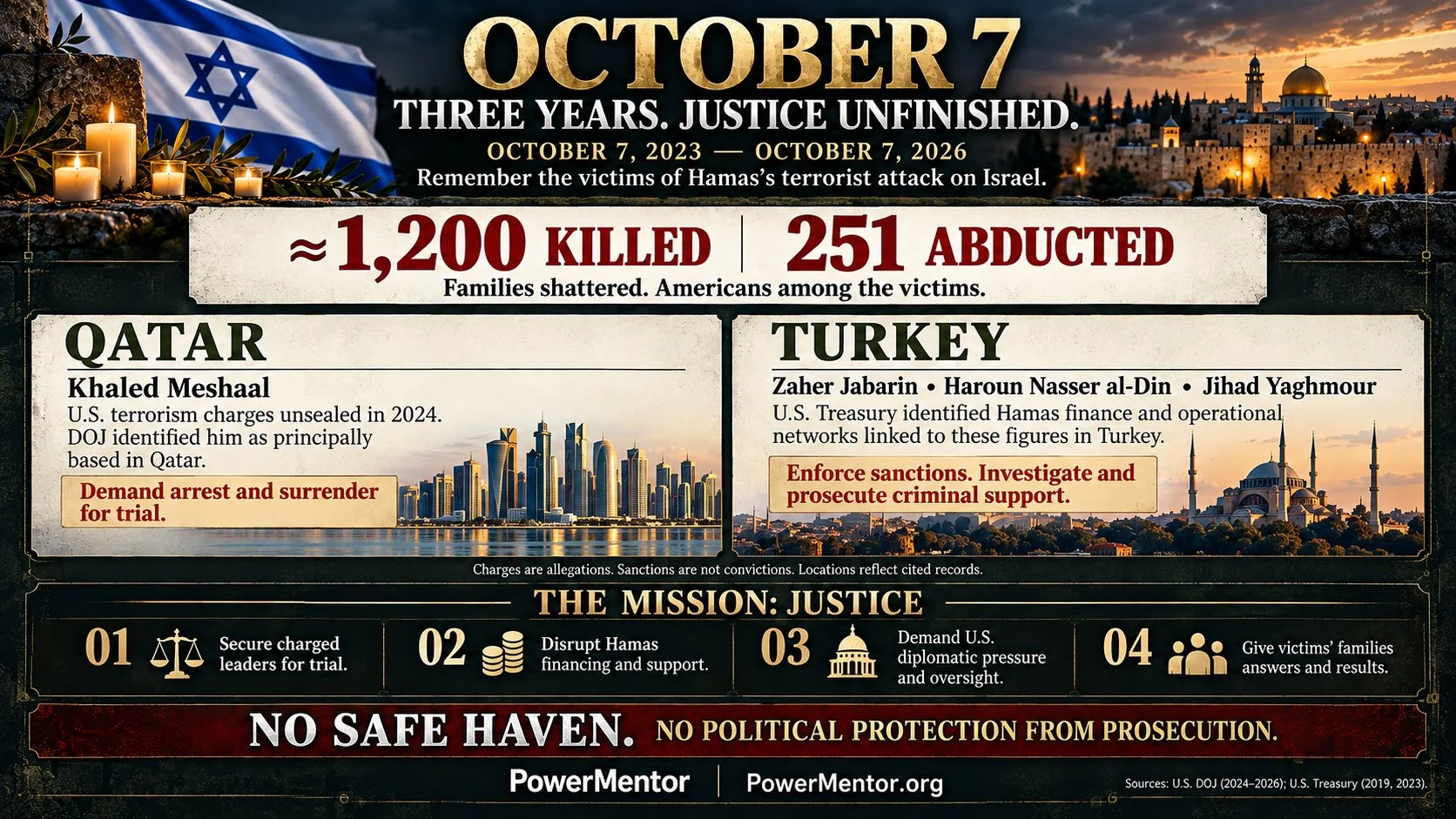
Three years ago today, Hamas brought terror into Israeli homes and communities. Approximately 1,200 people were killed, and roughly 250 were abducted. Americans were among the victims. Behind every number was a person with a family, a future, and a right to live. www.justice.gov
Those families have endured three years of grief, public promises, and unanswered questions.
On this anniversary, we should remember the murdered, honor the courage of survivors, and confront an unfinished responsibility: bringing the surviving perpetrators, organizers, and criminal enablers to justice.
A government’s commitment to its citizens is tested when justice becomes diplomatically inconvenient. It is tested when a wanted individual has powerful hosts, when a financier operates across borders, and when an ally would prefer that difficult questions disappear.
Those are precisely the circumstances in which leadership must become more determined.
PowerMentor’s position is clear: no political title, foreign residence, or negotiating role should protect a person from prosecution for proven participation in terrorism.
The evidence already extends beyond the people who crossed into Israel carrying weapons.
On September 3, 2024, the U.S. Justice Department unsealed a criminal complaint against six senior Hamas figures: Yahya Sinwar, Ismail Haniyeh, Mohammed Deif, Marwan Issa, Khaled Meshaal, and Ali Baraka. Prosecutors alleged leadership responsibility for Hamas’s terrorist campaign, including October 7. The seven counts included conspiracies involving material support, murder of Americans abroad, bombing public places, weapons of mass destruction, terrorism financing, and sanctions violations. United States Department of Justice
The charges require proof in court. That makes securing surviving defendants essential. A prosecution cannot deliver its full promise while the accused remain beyond the court’s reach.
Khaled Meshaal presents a direct test of American resolve. DOJ identified him as the head of Hamas’s diaspora office, principally based in Qatar. It identified another charged external leader, Ali Baraka, as principally based in Lebanon. These locations describe DOJ’s findings at the time, not verified whereabouts today. United States Department of Justice
The public records reviewed for this article did not establish that either man has since been brought into U.S. custody for trial. Washington should explain the status of its pursuit, within legitimate operational limits.
Deaths among other Hamas leaders do not discharge the obligation to pursue surviving defendants. Each outstanding case requires its own answer.
Qatar’s relationship with Hamas also involves figures beyond that criminal complaint. In August 2026, reporting in The Jerusalem Post, citing KAN and Palestinian sources, identified Khalil al-Hayya as Hamas’s newly selected political leader, based in Qatar. The report described his contacts with Turkish Foreign Minister Hakan Fidan and said Hamas was transferring planning, cyber, and other covert organizational activities to Turkey while retaining leadership and public-facing activities in Qatar. The Jerusalem Post
These are reported developments, not court findings. They nevertheless raise a serious question: Is pressure disrupting Hamas’s capabilities, or allowing them to relocate?
Al-Hayya was not one of the six defendants in the September 2024 complaint. His position should be examined through evidence about his own conduct. The same standard must apply to every leader: investigate the role, establish the facts, and prosecute where the evidence and law support it.
The scrutiny of Turkey is grounded in more than recent reporting. American authorities have publicly identified Hamas financial infrastructure there for years.
In September 2019, Treasury identified Zaher Jabarin, a Turkey-based Hamas finance chief, as a principal contact between Hamas and Iran’s Islamic Revolutionary Guard Corps–Quds Force. Treasury also described Turkey-based Redin Exchange as part of Hamas’s financial infrastructure. Its findings included involvement in a $10 million transfer to Hamas’s military wing, a $4 million transfer from the Quds Force, and a $2 million transfer from the Quds Force and Hezbollah. These findings predated October 7. U.S. Department of the Treasury
They demonstrate why scrutiny must reach the financial channels that sustain a terrorist organization over time.
In December 2023, Treasury named additional figures:
Haroun Nasser al-Din: A Turkey-based Hamas financial operative who worked with Jabarin and participated in a network transferring funds to Hamas’s command center in Hebron.
Jihad Yaghmour: Hamas’s representative to Turkey, whom Treasury described as involved in covert terrorist activities and using ostensibly legitimate cultural activities as cover.
Ali Baraka: The Lebanon-based external-relations official, whom Treasury sanctioned before he was named in the 2024 criminal complaint. home.treasury.gov
Sanctions identify targets for financial restrictions; criminal prosecutions require their own evidence. Both should be pursued with urgency where warranted.
Listing a name must lead to sustained enforcement. Investigators should trace transactions, identify intermediaries, disrupt unlawful transfers, and build cases against those knowingly enabling terrorism. Financial distance from a crime scene should never become practical immunity.
Congress has already demanded action from Turkey.
On November 22, 2024, Senators Ted Budd, Roger Wicker, and Joni Ernst called for the arrest and transfer of Hamas leaders facing U.S. charges. They invoked the U.S.–Turkey extradition treaty and argued that harboring terrorists implicated in killing allied citizens was incompatible with Turkey’s responsibilities as a NATO member. Budd’s office also documented earlier demands that Qatar hold Hamas leaders accountable. www.budd.senate.gov
Almost two years later, that appeal deserves a substantive follow-up.
Which requests were submitted? Which suspects were located? What responses did the host governments provide? What steps followed a refusal or delay?
The responsibility belongs to both the Justice Department and the State Department. DOJ develops cases and coordinates extradition requests. State presents requests through diplomatic channels and engages the foreign government. The Justice Manual expressly describes the American embassy’s role in formally presenting a request. www.justice.gov
The State Department cannot prosecute a defendant, but its diplomatic work can be essential to getting that defendant into a courtroom.
Diplomacy should support the pursuit of justice. A useful negotiating relationship must never quietly become indefinite protection from prosecution.
Qatar’s own recent cooperation makes this question especially concrete.
On July 10, 2026, DOJ announced that Abdullah Anwar had been extradited from Qatar to Texas in an unrelated criminal case. The department credited Qatari authorities and its Office of International Affairs with securing his arrest and transfer. www.justice.gov
That success does not mean every case has identical legal requirements. It demonstrates that Qatar can cooperate in returning a defendant to American custody.
In a July 23 analysis, Foundation for Defense of Democracies researcher Natalie Ecanow drew that comparison and called for stronger pressure to secure Meshaal’s extradition. Her conclusion about inadequate pressure is an assessment, not a complete record of private diplomacy. The underlying question remains compelling: What specific efforts have been made to secure Meshaal, and what is preventing his surrender? fdd.org
The public should not have to confuse secrecy with progress. Sensitive details can be protected while Congress receives meaningful oversight and victims’ families receive substantive updates.
There has been enforcement worth recognizing—and examining for what it shows is possible.
In March 2025, DOJ announced the leadership and membership of Joint Task Force October 7. Its stated mission included pursuing direct perpetrators, taking responsibility for the pending leadership cases, and securing defendants for prosecution in the United States. Bringing senior defendants to court was explicitly part of the assignment. www.justice.gov
On July 31, 2026, British authorities arrested Mohammad Yousef Hasna, an Istanbul resident, pending extradition proceedings. U.S. prosecutors alleged that he used his leadership role in a purported humanitarian organization to deliver financing and supplies to Hamas, coordinating with senior Hamas figure Ghazi Hamad. The allegations described cash deliveries, controlled distribution, and efforts to conceal where supplies were stored or delivered. United States Department of Justice
That case remains an accusation to be proved. It also demonstrates the value of coordinated international enforcement: a person based in Turkey was arrested while in another jurisdiction. Travel can create an opportunity to secure a defendant.
On October 2, 2026, DOJ announced another coordinated operation against alleged Hamas financing. It announced charges against Saleem Alzaq, arrests of Omar Adhami, Abdel Adhami, and Raed Yousef, and arrests in France of Faouzi Barika, Amel Oualid, and Nordine Barika. Authorities alleged a cross-border fundraising network, including cryptocurrency activity. United States Department of Justice
These actions matter. Investigators and prosecutors deserve support for pursuing difficult cases. Their work should strengthen the demand to complete the larger mission.
Arrests within supporting networks do not settle the outstanding cases against senior leaders.
PowerMentor calls for an accountability agenda with specific responsibilities and measurable results:
Pursue every outstanding leadership case. DOJ and the FBI should maintain an active plan for locating and securing each surviving charged defendant, including lawful opportunities created by international travel.
Press Qatar and Turkey for specific cooperation. State should seek arrests, surrender, evidence preservation, financial records, and assistance tied to identifiable cases. General assurances should be measured against actual responses.
Investigate senior figures beyond the existing complaint. Leadership, fundraising, command relationships, and knowledge of criminal operations should be examined. Where the evidence supports additional charges, prosecutors should bring them.
Enforce financial restrictions and pursue criminal facilitators. Follow the money through exchanges, intermediaries, companies, and organizations implicated by evidence. Protect legitimate humanitarian assistance by exposing and prosecuting deliberate diversion.
Require regular congressional oversight. Congress should receive a case-by-case account of obstacles, requests, responses, and next steps, using classified sessions when necessary. Operational secrecy must coexist with accountability.
Prepare consequences for obstruction. Washington should assess targeted sanctions, visa restrictions, and conditions on discretionary benefits where legally available and supported by evidence. Governments should understand the consequences of obstructing legitimate counterterrorism cooperation.
Give victims’ families meaningful updates. Assign clear points of contact and explain what can be disclosed. Families should not have to rely on anniversary broadcasts to learn whether their cases are advancing.
These demands should apply regardless of who occupies the White House. The 2024 charges, the 2025 task force, and the subsequent enforcement actions create a continuing responsibility. No administration inherits permission to let the work fade.
Justice must remain focused on the individuals and institutions whose conduct can be established through evidence. That precision gives the pursuit its legitimacy and strength.
For PowerMentor, leadership means accepting responsibility for the unfinished task. It means standing with victims when attention moves elsewhere. It means insisting that commitments survive the press conference and the anniversary.
Three years after October 7, the murdered cannot speak for themselves. Their families can—and those with the power to act must listen.
Remember their lives. Pursue those responsible. Demand results.
No safe haven. No political protection from prosecution. No expiration date on the pursuit of justice.
