

Chikungunya in Southern China (2025): Foshan’s Explosive Outbreak and Global Public Health Implications
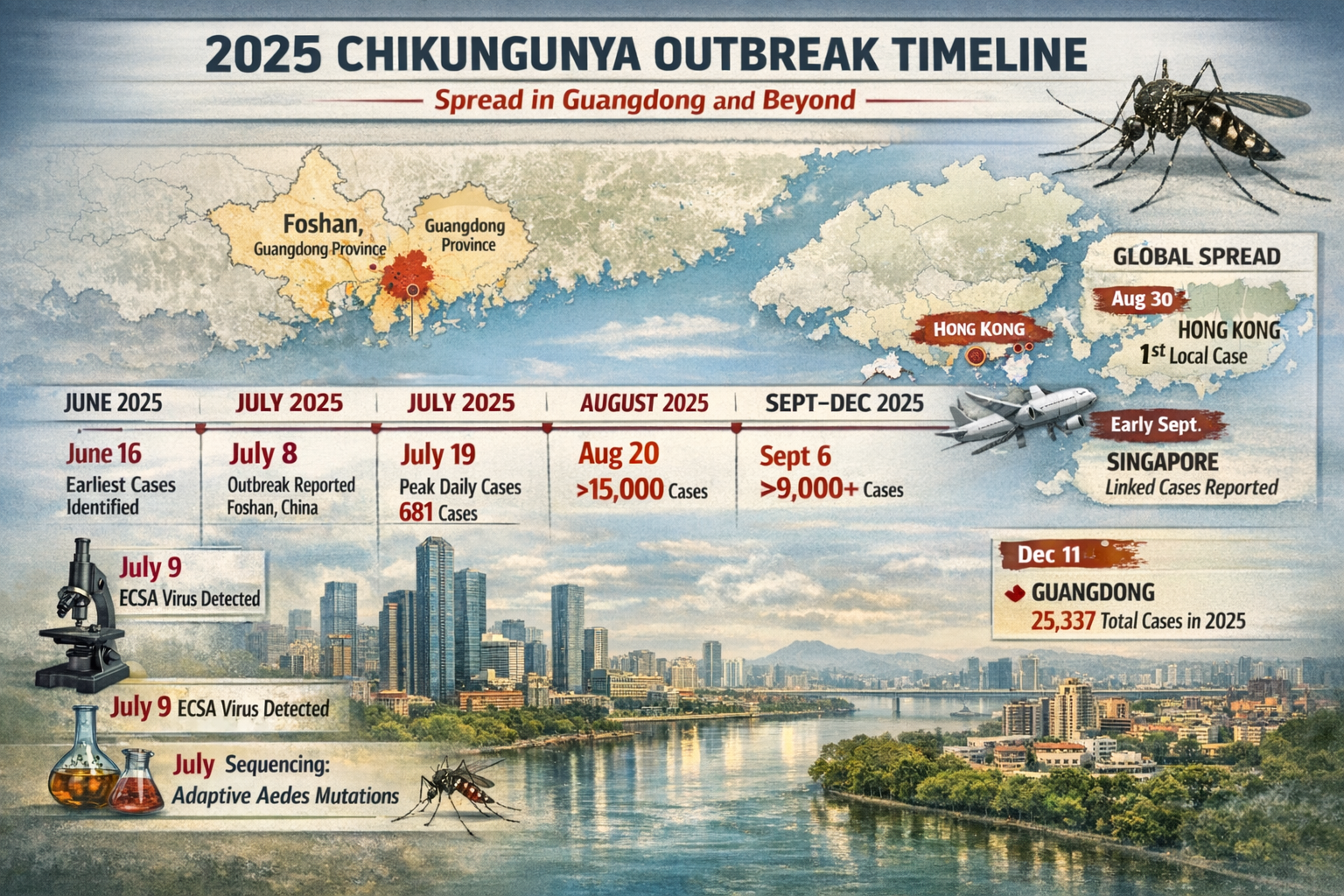
Public Health Alert Snapshot (as of December 19, 2025)
A large chikungunya outbreak emerged in Foshan City (Shunde District), Guangdong Province, in summer 2025 and rapidly became the largest documented chikungunya outbreak in China to date. China CDC Weekly
Clinical illness has largely matched classic chikungunya—acute fever + severe joint pain + rash—with reports from early outbreak investigations indicating mild disease overall and no recorded deaths in the Foshan case series. China CDC Weekly
1) What happened in Foshan—and why it spread so fast
Timeline and scale (key milestones)
Early symptom onsets: The Foshan outbreak investigation recorded an earliest symptom onset of June 16, 2025, with a recognized cluster reported in early July. China CDC Weekly
Rapid acceleration: Reporting describes the outbreak as beginning in Foshan on July 8, 2025, surpassing 3,000 confirmed cases in ~2 weeks, and exceeding 10,000 by late August. University of Nebraska Medical Center
Province-wide spread: By July 26, 2025, 4,824 confirmed cases had been reported across 12 prefecture-level cities in Guangdong—98.5% occurring in Foshan, most concentrated in Shunde District. China CDC Weekly
By late September: WHO reported 16,452 locally transmitted cases in Guangdong by September 27, 2025, calling it China’s largest documented chikungunya outbreak. World Health Organization
By December: The U.S. CDC issued/maintained a Level 2 (Practice Enhanced Precautions) travel notice for chikungunya in Guangdong Province (updated December 17, 2025). CDC
Why Foshan was a high-risk “perfect storm”
Multiple factors appear to have amplified transmission:
Vector suitability: Guangdong has abundant Aedes mosquitoes (especially Aedes albopictus in many parts of the region). China CDC Weekly
Virology that favors spread via Aedes albopictus: Investigators identified the outbreak strain as ECSA genotype (reported as Central African clade/ECSA) and other analyses noted features consistent with urban spread patterns and rapid “patchy” expansion into immunologically naïve areas. China CDC Weekly
Low population immunity: Experts quoted in reporting emphasized that limited prior exposure can allow very fast outbreaks once the virus is introduced. AP News
Weather and breeding conditions: Late spring/summer conditions and storm/rain patterns can increase standing water and mosquito reproduction, raising the force of transmission. OUP Academic
2) Clinical picture: symptoms, course, and who is most at risk
Typical symptoms (what most people experience)
Incubation: Symptoms usually start 3–7 days after a bite (range can be wider). CDC
Core symptoms:
Fever
Severe joint pain (arthralgia)
Rash CDC
In Foshan’s early outbreak dataset, high proportions had fever, joint pain, and rash, and many had all three together. China CDC Weekly
Severity and complications
Chikungunya is usually not fatal, but it can be debilitating—especially because joint pain may persist for months (and sometimes longer). CDC+1
People at higher risk for severe disease include older adults, newborns infected around the time of birth, and people with certain underlying medical conditions. CDC
3) How chikungunya spreads (and what it does not mean)
Primary transmission: mosquito → human → mosquito
Chikungunya is spread mainly by bites from infected Aedes mosquitoes. China CDC Weekly
A crucial public-health point is that ill people can be infectious to mosquitoes during the viremic phase—so preventing mosquito bites around symptomatic cases helps break transmission chains. Centre for Health Protection
What this is not
It is not primarily a “close contact” respiratory outbreak. Control success depends far more on vector control, personal bite prevention, and rapid detection than on measures like masking or airborne precautions. (That said, outbreak responses may still use isolation to keep patients in mosquito-free environments.) China CDC Weekly
4) Public health response: what worked, what was controversial
Foshan/Guangdong control measures (core playbook)
Outbreak investigators describe a layered response that included:
Enhanced surveillance + differential screening (especially to distinguish chikungunya from dengue in febrile patients) China CDC Weekly
Routine CHIKV nucleic-acid testing in healthcare settings in affected areas China CDC Weekly
“Case-centered” vector control: protective measures around confirmed cases within days of symptom onset (e.g., treated screens/nets, residual repellents in living spaces) China CDC Weekly
Community vector control: adulticide spraying and breeding-site elimination in defined radii around case locations, guided by mosquito indices (e.g., Breteau Index) China CDC Weekly
Hong Kong’s spillover risk management (example of cross-border vigilance)
Hong Kong issued clinician communications urging vigilance regarding Guangdong’s outbreak and emphasized mosquito-free isolation for suspected hospitalized cases. Centre for Health Protection
By mid-December, Hong Kong reported local transmission clusters tied to specific outdoor areas (e.g., Tsing Yi Nature Trails) and implemented closures and intensified mosquito control. Centre for Health Protection
Controversies and trust impacts
Some reporting raised concerns that certain containment practices (e.g., aggressive inspections/monitoring) risked eroding public trust and triggering backlash—an important reminder that public cooperation is itself a control tool in mosquito-borne outbreaks. The Guardian
5) Global impact so far: why this outbreak mattered beyond China
A) Travel-associated spread and regional signaling
Foshan’s outbreak quickly became a regional warning sign: when a major urban center experiences explosive mosquito-borne spread, nearby jurisdictions with the same vectors and heavy travel flows must assume importations will happen. Travel-associated cases and heightened vigilance were noted in nearby areas in outbreak reporting summaries. University of Nebraska Medical Center
B) A 2025 chikungunya “resurgence” context
WHO described 2025 as a year with renewed chikungunya activity across multiple regions and flagged the risk of spread in settings with competent vectors. World Health Organization
Other public-health trackers and summaries cite hundreds of thousands of suspected/confirmed chikungunya cases globally in 2025, with reported deaths—underscoring that Foshan wasn’t occurring in isolation, but amid a broader resurgence pattern. Travel Health Pro
C) Why this raises concern for temperate countries too
Aedes albopictus (“tiger mosquito”) is established in parts of Europe and other temperate regions. When chikungunya is imported during mosquito season, local transmission becomes possible—so a large outbreak in a major travel-connected hub increases the probability of “sparks” landing elsewhere (even if only a few ignite). CDC
6) Practical guidance (public health alert format)
For the public (especially in or traveling to affected areas)
Prevent mosquito bites (daytime too): repellent, long sleeves/pants, screened/AC lodging. CDC
Eliminate standing water (breeding sites) around homes/workplaces. (Core vector-control principle emphasized across outbreak responses.) China CDC Weekly
If you develop fever + joint pain + rash after travel or mosquito exposure: seek medical care and avoid mosquito bites while sick to reduce onward spread. CDC
For clinicians and health systems
Consider chikungunya in compatible illness, especially with travel/exposure risk; test during acute illness using molecular methods where available. China CDC Weekly
Mosquito-free care environments for febrile suspected/confirmed cases can reduce mosquito infection and community spread. Centre for Health Protection
For public health agencies
Integrated vector management (source reduction + targeted adulticide + real-time indices) plus case-centered mosquito protection is strongly supported by Foshan’s response description. China CDC Weekly
Risk communication that preserves trust matters—compliance and community participation are essential in mosquito control. The Guardian
7) Vaccines and prevention: what changed in 2025
Chikungunya vaccination guidance evolved rapidly in 2025:
The virus-like particle vaccine (VIMKUNYA) (Bavarian Nordic) was licensed by the U.S. FDA in February 2025, and ACIP approved recommendations for certain travelers and lab workers. CDC
The live-attenuated vaccine IXCHIQ faced significant safety concerns; the FDA suspended the U.S. license on August 22, 2025, and CDC posted notices accordingly. CDC
Bottom line: bite prevention remains the foundation, while vaccine decisions are risk- and product-specific and should follow current national guidance. CDC
References
Centers for Disease Control and Prevention. (2025, November 19). Symptoms, diagnosis, & treatment: Chikungunya virus. CDC
Centers for Disease Control and Prevention. (2025, December 17). Chikungunya in China – Level 2: Practice enhanced precautions. CDC+1
Centers for Disease Control and Prevention. (2025, August 22). Chikungunya vaccine information for healthcare providers. CDC
Centers for Disease Control and Prevention. (2025, August 22). Chikungunya vaccines. CDC+1
Centre for Health Protection, Department of Health, Hong Kong SAR. (2025, July 16). An outbreak of chikungunya fever reported in Guangdong (Letters to doctors). Centre for Health Protection
Centre for Health Protection, Department of Health, Hong Kong SAR. (2025, December 19). Latest situation on chikungunya fever (provisional figures as of 19 December 2025). Centre for Health Protection
Food and Drug Administration. (2025, August 22). FDA update on the safety of Ixchiq (chikungunya vaccine, live). U.S. Food and Drug Administration
Food and Drug Administration. (2025, March 13). VIMKUNYA (chikungunya vaccine, recombinant). U.S. Food and Drug Administration
Li, Y., Jiang, S., Zhang, M., Li, Y., He, J., Yang, Z., Huang, X., Guan, Q., Li, Z., Xie, J., Lin, Q., Li, H., Li, W., Lam, Y., Zhou, L., & Kang, M. (2025). An outbreak of chikungunya fever in China — Foshan City, Guangdong Province, China, July 2025. China CDC Weekly. doi:10.46234/ccdcw2025.172 China CDC Weekly
World Health Organization. (2025, October 3). Chikungunya virus disease – Global situation (DON581). World Health Organization+1
Tee, K. K., Mu, D., & Xia, X. (2025). Explosive chikungunya virus outbreak in China. International Journal of Infectious Diseases, 161, 108089. doi:10.1016/j.ijid.2025.108089 PubMed+1
European Centre for Disease Prevention and Control. (2025, November 17). Chikungunya virus disease worldwide overview (monthly). ECDC+1
