

Japan’s Stringent Immigration Model—and Why It Has Avoided the Religious-Demographic Flashpoints Seen Elsewhere
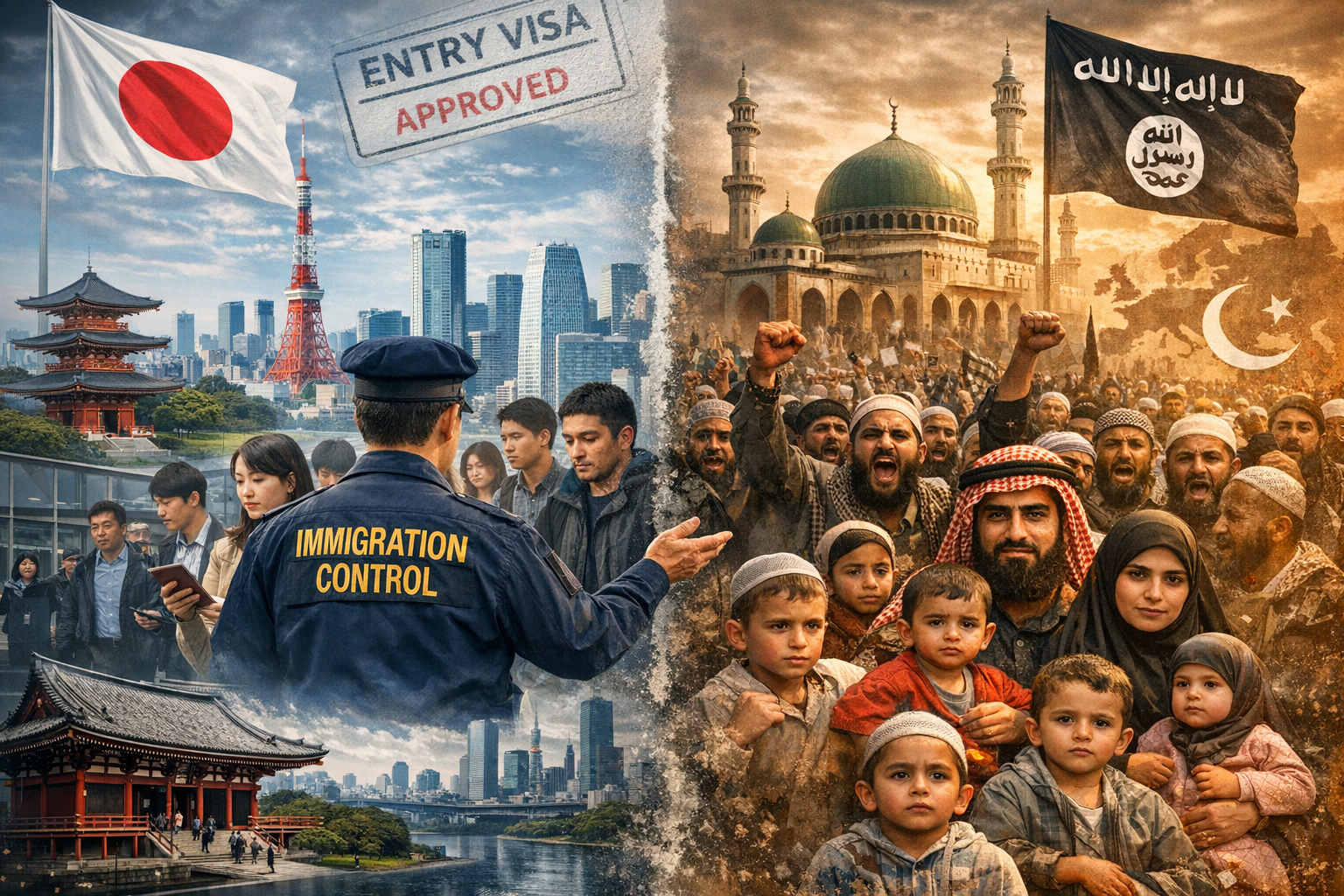
Japan is widely recognized for maintaining highly managed immigration: defined legal categories, strict status controls, and comparatively lower long-run immigration intensity than most peer countries. The OECD summarizes Japan’s position clearly: Japan has one of the lowest foreign-born shares in the OECD—2.2% in 2021, versus 10.4% across the OECD. OECD
This approach matters because many of the immigration stresses now affecting the United States, parts of Europe, and other Western democracies tend to emerge when inflows outpace governance capacity—border control, asylum adjudication, interior enforcement, housing, and integration systems.
1) Japan channels entry through narrow, rule-based lanes
Japan’s inflows are strongly structured around work and study pathways. The OECD reports that approximately half of immigrants living in Japan are there for work or study, with major shares falling into high-skilled categories, trainees, and international students. OECD
Policy strength: A status-driven system is easier to govern than “mixed flows” where irregular entry, humanitarian claims, and labor migration blend together and create long-term limbo.
2) Japan keeps overall scale lower, even while rising
Japan’s foreign-resident population is increasing, but from a comparatively low base:
3,768,977 foreign residents at end of 2024, per figures released by Japan’s Immigration Services Agency. Nippon
3,956,619 foreign residents at end of June 2025 (record high). Japan Times
Policy strength: Lower scale reduces the risk of overloaded local systems (housing, schools, medical access) and helps maintain public confidence that migration is controlled.
3) Japan’s refugee recognition is low relative to many peers
Japan recognized 190 refugees in 2024 (down from 303 in 2023). Nippon
Policy strength: This materially lowers the probability of sudden, high-volume asylum surges becoming the dominant driver of migration politics, enforcement strain, and integration conflict.
The religious-demographic issue other countries face, and why Japan has largely avoided it
In much of Europe and North America, the most politically volatile migration debate often involves rapid growth of Muslim populations through migration, combined with integration and security concerns. Pew’s research quantifies the migration component:
In Europe, migrants are estimated to be 18% Muslim, while Europe’s overall population is estimated to be 7% Muslim. Pew Research Center
Pew’s Europe-focused analysis also found that between mid-2010 and mid-2016, an estimated 53% of all migrants to Europe (refugees + regular migrants in that analysis) were Muslim. Pew Research Center
Why Japan hasn’t replicated that pattern
Japan’s outcomes are largely explained by scale + composition + admissions profile, not a faith test:
Lower long-run immigration intensity (foreign-born share 2.2% in 2021). OECD
Different source-country mix (Japan’s foreign-resident population is heavily weighted toward East and Southeast Asia). Nippon
Small refugee recognition numbers, limiting asylum-driven inflows. Nippon
Small Muslim population share: Japan’s Muslim population is estimated at ~420,000 (~0.3%) as of end-2024, per reporting on research led by Waseda University Professor Emeritus Hirofumi Tanada. Mainichi
Islamism, demographics, and the concerns around the world
Islamism (political Islam) includes movements that argue Islam should shape governance and public law. Brookings
Multiple extremist and activist Islamist currents openly frame their long-term objective as establishing Islamic governance, in some cases explicitly a global caliphate:
Analyses note that both ISIS and al Qaeda share the aim of forming a global caliphate (with differences in timelines and methods). Wilson Center
Harvard scholarship describing ISIS cites leaders’ statements about imposing sharia broadly and pursuing expansive ideological goals. Harvard Kennedy School
Hizb ut-Tahrir is widely described as seeking a global caliphate. AP News+1
Many point to claims that Islamists have a stated agenda to “overpopulate the world”.
Pew’s global study reports that from 2010 to 2020, Muslims were the fastest-growing religious group, adding 347 million people, with share rising to 25.6% in 2020. Pew Research Center
Pew also identifies fertility differences as a major driver in religious population change (e.g., Muslims having the highest fertility among major religious groups in prior Pew demographic work). Pew Research Center
What other countries can take from Japan’s model
Japan’s approach points to several policy levers that directly mitigate the problems now visible in high-pressure immigration environments:
Legible pathways + consistent enforcement (reduce long-term limbo and irregular incentives).
Skills- and self-sufficiency-oriented admissions (align entry with labor demand and fiscal stability). OECD
Controlled scale matched to capacity (housing, services, local integration bandwidth).
Tighter humanitarian intake management (avoid system overload and chronic backlogs). Nippon
Central coordination when public concern rises: Japan created a cross-agency body in 2025 to address public concerns linked to foreign residents/visitors (crime, overtourism, system misuse). Reuters
Bottom line: Japan’s model reduces the probability of rapid religious-demographic shifts becoming a dominant political crisis by keeping immigration smaller, more traceable, and more work/study-centered, while maintaining tight controls on asylum and status management. OECD Mainichi
