
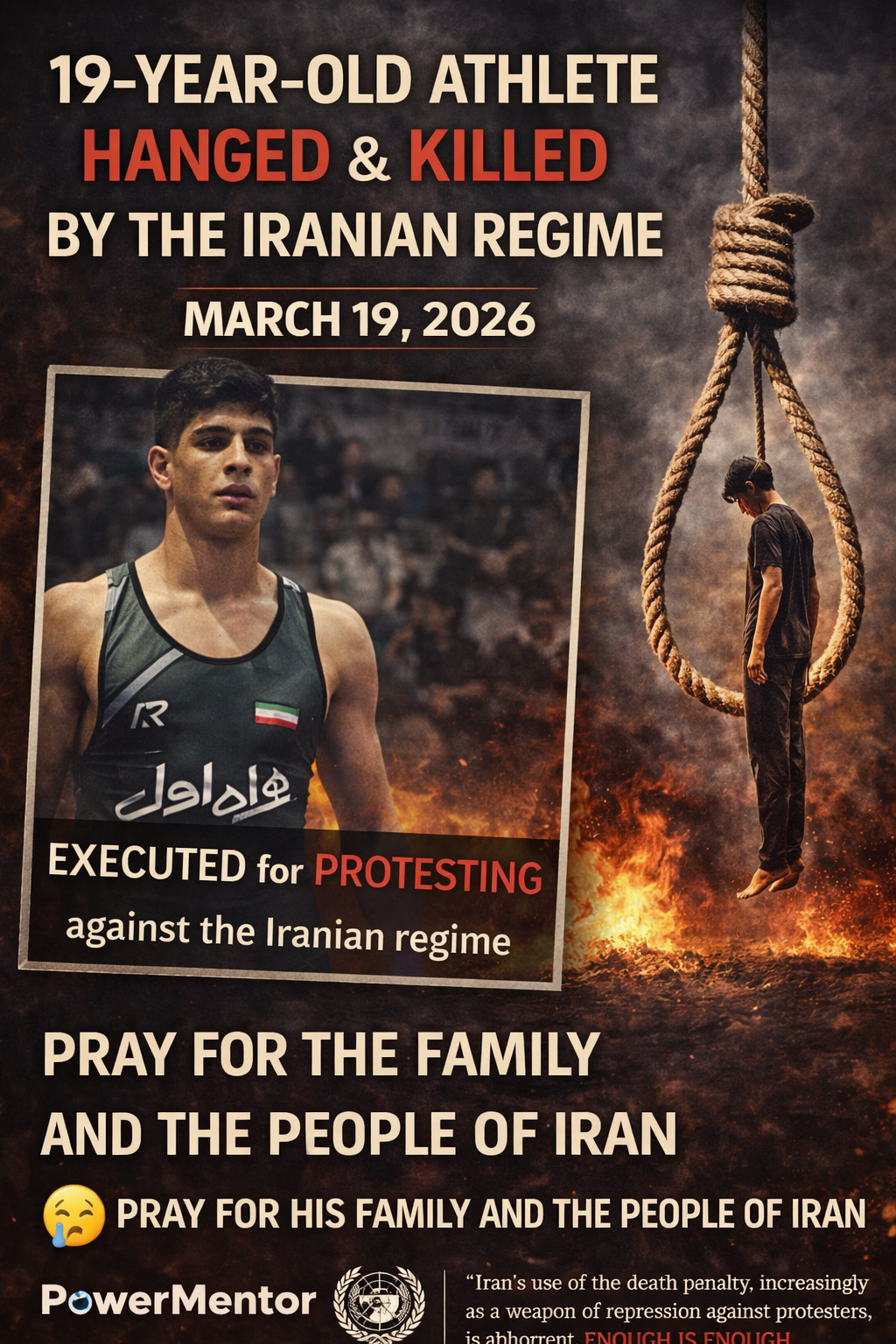
UPDATE: SALEH WAS HUNG AND KILLED TODAY MARCH 19, 2026! Condemned at 19: How Iran’s Regime Uses Death Sentences to Terrorize a Nation
Condemned at 19: How Iran’s Regime Uses Death Sentences to Terrorize a Nation
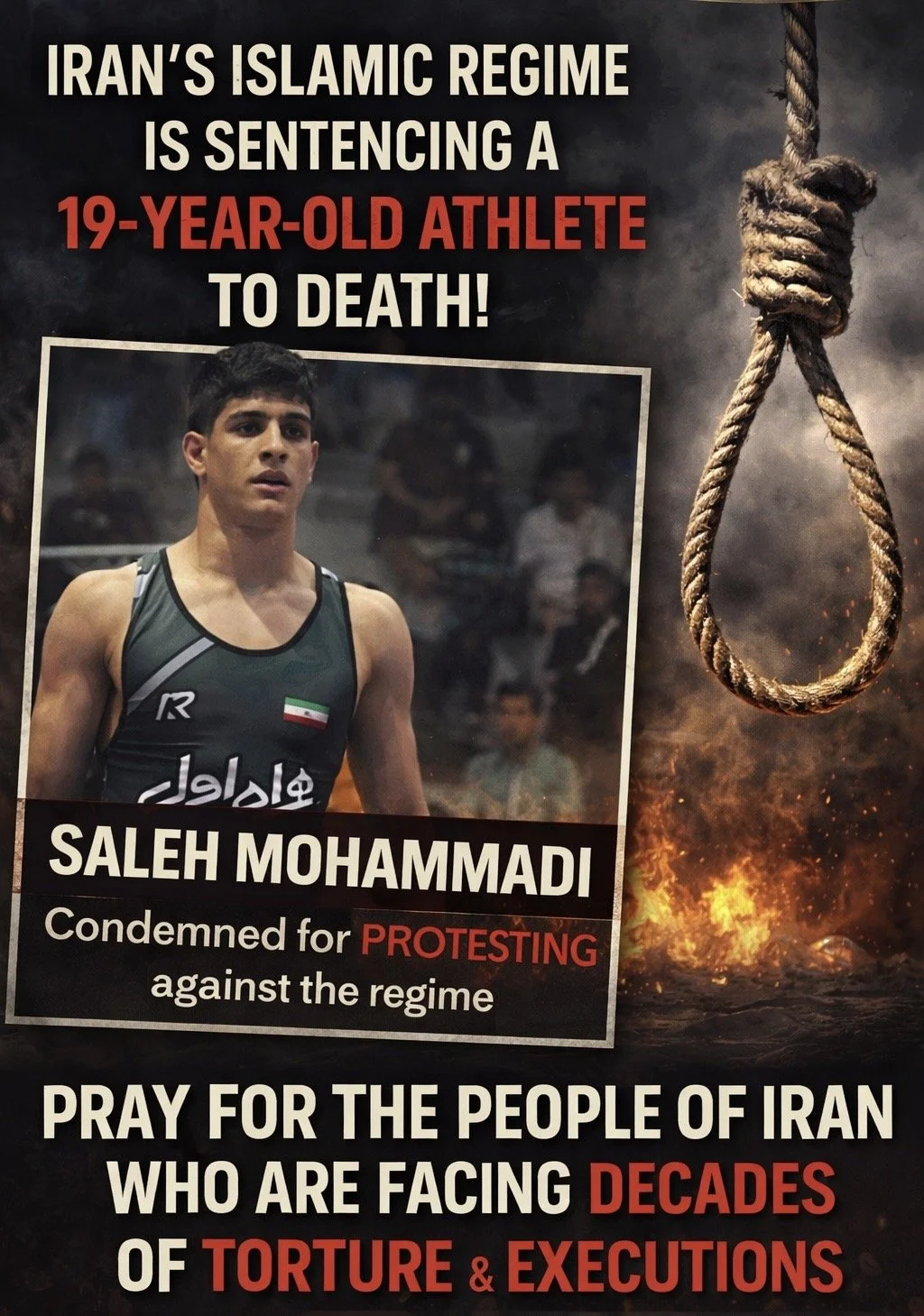
Iran’s Islamic Republic has reportedly condemned Saleh Mohammadi, only 19 years old, to death. The young Iranian wrestler is being held in solitary confinement and faces imminent execution after being charged with “waging war against God”—a religiously framed accusation tied solely to his participation in anti-regime protests.
At 19, Saleh Mohammadi should be training, studying, building a future. Instead, the state is preparing a gallows.
This is not an aberration. It is how the regime governs.
A Familiar and Deadly Playbook
The Islamic Republic has perfected a system for eliminating dissent:
Identify a visible dissenter (often youth, athletes, artists, or students).
Arrest and isolate—frequently in facilities like Evin Prison.
Apply vague capital charges such as moharebeh (“waging war against God”) or efsad-e fel-arz (“corruption on earth”).
Extract confessions under psychological or physical coercion.
Rush execution to preempt international pressure.
Saleh’s case mirrors this pattern precisely.
Athletes as Targets: Why the Regime Is Afraid
Athletes represent national pride and unity—qualities authoritarian regimes cannot fully control. When athletes stand with the people, the regime responds with exceptional brutality.
In 2020, Navid Afkari was executed after participating in protests. Evidence of torture and forced confession was ignored. Global pleas were dismissed. His execution sent a clear signal: no one is too young, too famous, or too loved to be spared.
By sentencing a 19-year-old athlete to death, the regime escalates that message—aimed squarely at Iran’s youth.
“Waging War Against God”: Law as a Weapon
The charge of moharebeh is not a neutral legal concept; it is a political weapon. Peaceful protest is recast as a divine offense, allowing the state to claim moral authority while silencing opposition.
International human rights bodies have repeatedly warned that these charges:
Violate due process
Criminalize freedom of expression and assembly
Enable arbitrary executions
Yet the practice continues—because fear works.
Four Decades of Systematic Suffering
Since 1979, Iranians have endured a regime that rules through intimidation:
Thousands executed, including juveniles and political prisoners
Women punished, imprisoned, or killed for resisting compulsory hijab laws
Ethnic and religious minorities persecuted under discriminatory statutes
Students and youth treated as enemies of the state
Families terrorized, forced to watch silence become survival
Each generation inherits the trauma of the last. Parents who survived mass executions in the 1980s now fear for children born long after those atrocities—children like Saleh.
Why This Case Matters Now
Executing a 19-year-old protester is not about enforcing law—it is about breaking a movement. The regime understands that Iran’s youth are its greatest threat: educated, connected, unafraid of inherited fear.
Saleh Mohammadi’s life is being used as a warning to millions.
A Call That Cannot Be Ignored
This is a moment for moral clarity. Neutral language and euphemisms only serve the executioner.
Saleh Mohammadi is 19 years old.
His “crime” is protest.
His sentence is death.
Pray for the people of Iran who are standing against this wicked, violent regime.
Pray for the young men and women in solitary cells.
Pray for families waiting outside prison gates.
And pray that the machinery of terror does not get the last word.
References
Amnesty International. (2023). Iran: Death sentences and executions used to crush dissent. https://www.amnesty.org
Amnesty International. (2020). Iran: Navid Afkari executed after unfair trial and torture. https://www.amnesty.org
Human Rights Watch. (2023). “They Are Trying to Kill Us”: Iran’s use of capital punishment against protesters. https://www.hrw.org
International Covenant on Civil and Political Rights. (1966). United Nations Treaty Series, 999, 171.
United Nations Human Rights Council. (2024). Situation of human rights in the Islamic Republic of Iran: Report of the Special Rapporteur. https://www.ohchr.org
United Nations Office of the High Commissioner for Human Rights. (2022). Iran protests: Excessive force, arbitrary detention and executions. https://www.ohchr.org
